
 KB News Desk
Chains seek growth abroad as domestic saturation and rising costs squeeze margins
Korea’s budget coffee chains, built on affordability and accessibility, may be pushing the market to saturation, and rising bean prices and currency pressure are squeezing margins further.
Instead, the chains are betting on markets abroad, leaning on Korean identity as their edge, especially as interest in K-food and other content keeps rising.
This month has already brought a string of openings abroad, each a day apart.
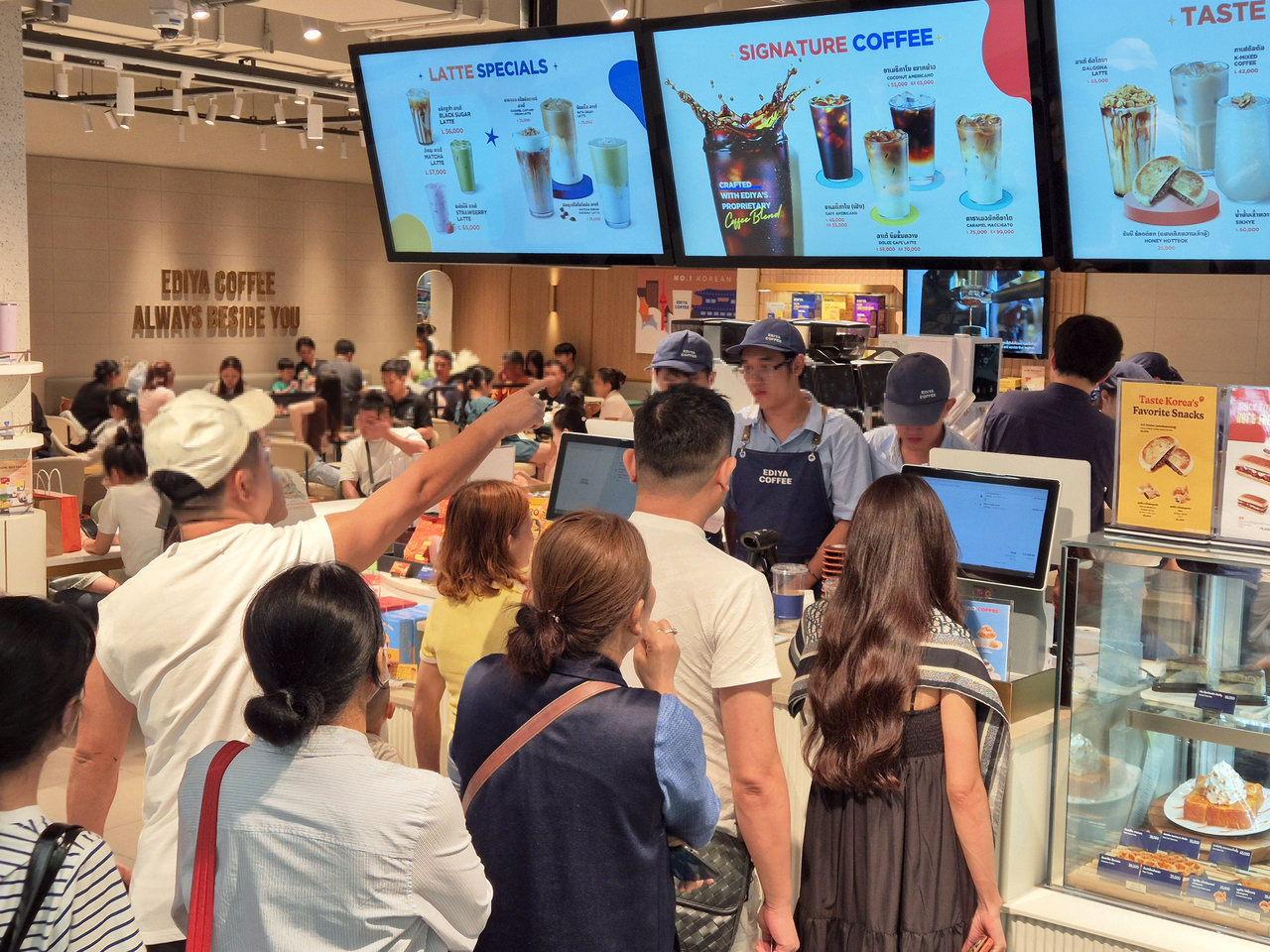
Ediya Coffee opened its first store in Laos on Saturday through a master franchise deal with Kolao Group, following earlier entries into Guam, Malaysia and Canada.
Compose Coffee and The Venti both opened their first Philippine stores last week.
Compose launched Friday at a mall in Manila, backed by a master franchise agreement with Jollibee Group’s Fresh N’ Famous Foods, after a strong pre-opening period, while The Venti opened the day prior, after signing a master franchise agreement with JJR Brothers Food Corp., with a second location planned later this year.
Beneath each of these openings lies a shared conviction that an identity rooted in Korean culture will resonate with local consumers abroad.
Ediya, for one, kept domestic hits like dalgona latte with Southeast Asia’s appetite for milk-based coffee in mind, carrying that same Korean flavor into its desserts. “We are also rolling out tumblers with traditional Korean patterns and keyrings modeled on traditional ornaments,” a company official said.
Mega Coffee and Paik’s Dabang have laid similar groundwork elsewhere.
Mega Coffee runs eight stores in Mongolia and has set up a Japanese subsidiary, with a US launch still being mapped out. Nothing has been confirmed regarding its timing or format, the company noted.
Paik’s Dabang operates 17 stores in the Philippines and runs two shop-in-shop locations in China. It recently opened its first Tokyo store under a new identity that keeps “dabang,” the traditional Korean word for coffeehouse.
The company cast its overseas push not as an escape from a cooling domestic market, but as confidence in its own global competitiveness. “Starting with Japan, we plan to bring the brand to China, Taiwan and the US,” a Paik’s Dabang official said.
According to industry officials, budget coffee has reached an inflection point where added stores no longer yield more profit, thereby driving chains toward overseas expansion and menu diversification to broaden their revenue base.
From here on, brand value and menu strength should matter as much as low prices once did, with features like smart ordering entering the mix, they noted.
“Low prices alone won’t be enough to sustain popularity abroad,” one industry official said. “Success will depend on building a stable local supply chain to optimize cost structure, along with a strong localization strategy.”