
 KB News Desk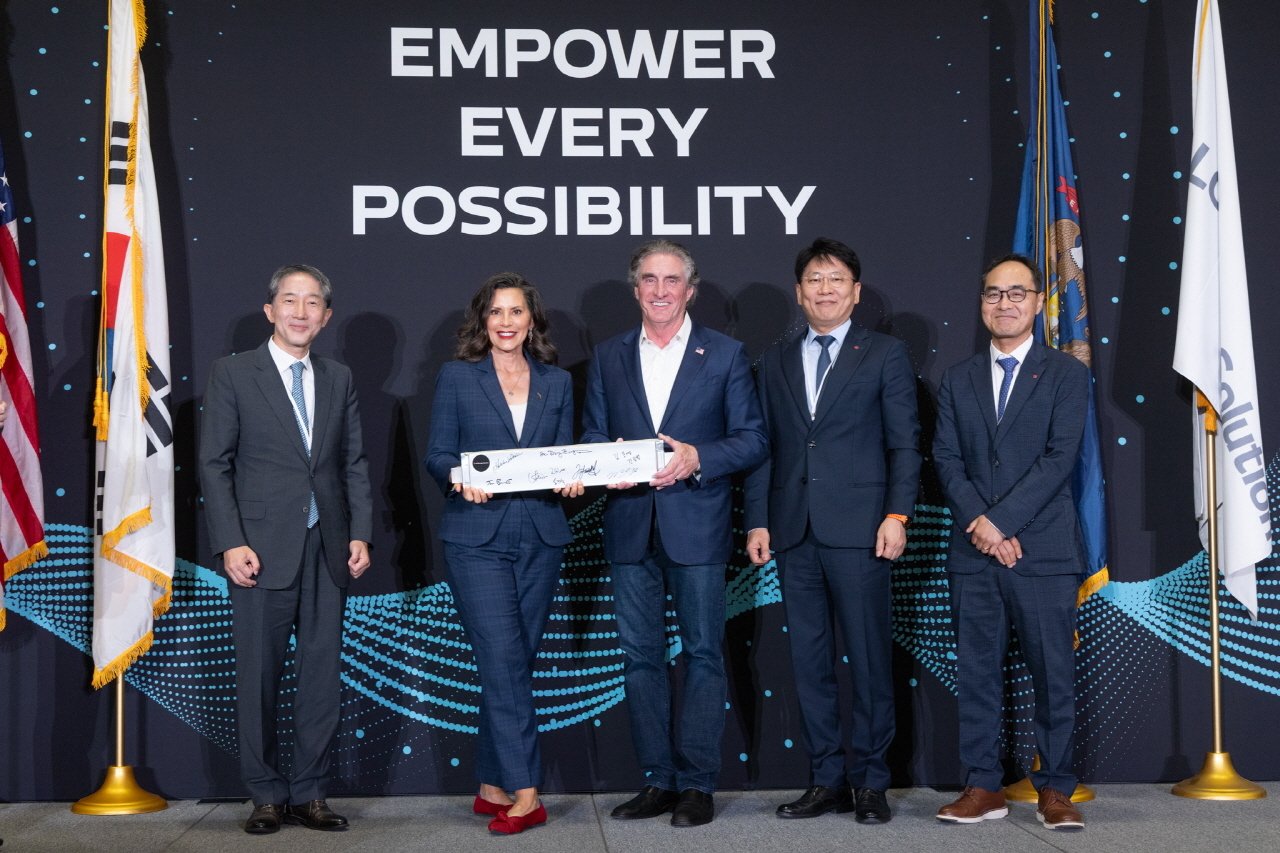
35-GWh facility to supply storage systems, Toyota EVs, as North American orders surge
South Korean battery-maker LG Energy Solution said Wednesday it has begun operations at its battery plant in Lansing, Michigan, aimed at capturing growing demand for energy storage systems in North America.
The company said it held an opening ceremony for the LG Energy Solution Michigan-Lansing facility on Tuesday, marking its seventh production plant in North America.
The ceremony was attended by Michigan Gov. Gretchen Whitmer, US Interior Secretary Doug Burgum, Republican Rep. Tom Barrett of Michigan, South Korean Consul General in Chicago Hong Sang-woo and senior LG Energy Solution executives, including CEO Kim Dong-myung and Choi Dae-sik, head of the company’s Michigan operations.
The plant will manufacture both lithium iron phosphate batteries for energy storage systems and nickel-cobalt-manganese batteries for electric vehicles. Its total annual battery cell production capacity will exceed 35 gigawatt-hours.
With the Lansing facility now operational, LG Energy Solution said it has established five manufacturing bases supporting its ESS business in North America.
The network consists of three wholly operated facilities, including the Lansing and Holland plants in Michigan and NextStar Energy’s plant in Ontario, as well as two joint venture facilities: the L-H Battery Co. plant in Ohio with Honda and the Ultium Cells plant in Tennessee with General Motors.
“Launching the Lansing facility marks an important milestone that will accelerate the growth of LG Energy Solution’s North American business,” CEO Kim said. “We will continue strengthening the US battery ecosystem and expanding our local manufacturing capabilities by establishing an advanced battery manufacturing network that supports the future of America’s mobility industry and energy infrastructure.”
LFP batteries for energy storage systems produced in Lansing will be supplied through LG Energy Solution subsidiary Vertech to customers in power infrastructure and artificial intelligence data centers.
LG Energy Solution has secured an ESS order backlog of approximately 140 gigawatt-hours, mainly in North America, as of the end of 2025. It has won more than 3 trillion won in new orders in the first half of this year alone.
The plant will also produce EV batteries for Toyota. Those batteries are expected to be used in vehicles including the 2027 Highlander manufactured at Toyota’s plant in Georgetown, Kentucky.
US Interior Secretary Burgum also highlighted the Lansing facility’s role in strengthening domestic manufacturing and reducing reliance on overseas supply chain.
“With its skilled workforce, manufacturing expertise and industrial infrastructure, Michigan plays a pivotal role in strengthening the US battery supply chain,” Burgum was quoted as saying, adding the Donald Trump administration will continue supporting the return of critical manufacturing to the US and expanding the country’s capacity to produce key technologies domestically.
The opening comes as South Korea’s major battery-makers pivot toward ESS to cushion the impact of a prolonged slowdown in global EV demand. They have been focusing on expanding their ESS businesses to capitalize on rising demand driven by the rapid buildout of AI data centers, renewable energy projects and expanding power infrastructure.
The US ESS market is expected to grow fourfold by 2031, with new installations expected to reach 499 gigawatt-hours in capacity, according to market research firm Wood Mackenzie.