
 KB News Desk
Industrial users outside southern Seoul and southern Gyeonggi Province could save a combined 2.8 trillion won ($2 billion) a year in electricity costs under a regional pricing system the government aims to introduce by the end of this year.
The biggest savings would be available in southern Korea, where industrial electricity rates could be cut by as much as 18 won per kilowatt-hour, or roughly 10 percent of last year’s average industrial electricity rate.
For large power users such as semiconductor plants and data centers, that difference could translate into billions or even tens of billions of won in annual savings, potentially influencing where companies choose to invest.
The Ministry of Climate, Energy and Environment and state-run Korea Electric Power Corp. unveiled the proposed pricing structure at a public hearing held Wednesday at KEPCO’s headquarters in southern Seoul.
The plan follows the implementation of the Special Act on the Promotion of Distributed Energy in June 2024, which created the legal basis for regionally differentiated electricity rates.
Industrial customers are currently subject to the same electricity pricing system nationwide.
The uniform system has been criticized for failing to reflect regional differences in power generation, consumption and transmission costs, even as demand remains heavily concentrated in the Seoul metropolitan area.
“Greater Seoul sources about 40 percent of its industrial electricity demand from outside the region, resulting in substantial costs for long-distance transmission and grid construction,” a KEPCO official said Wednesday.
“With differentiated electricity rates, industries will have greater incentives to relocate to regions with more favorable electricity costs, helping attract local investment and boost regional economies.”
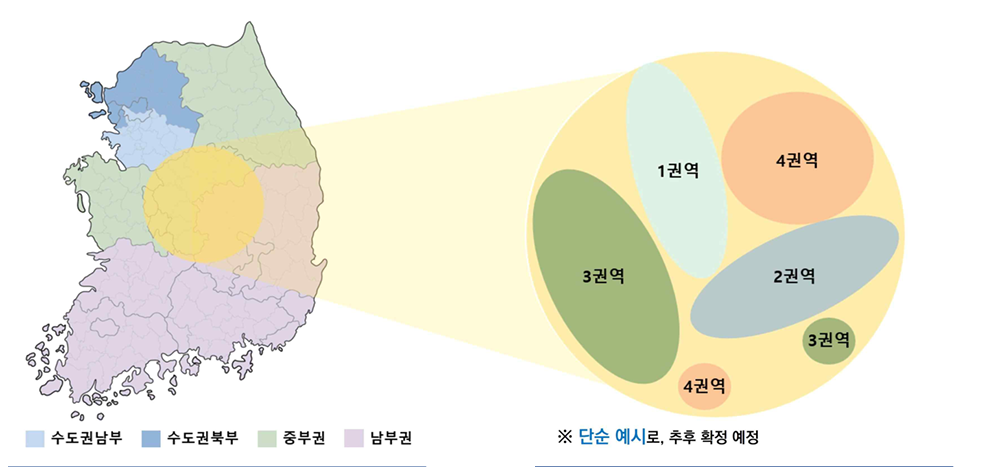
Under the proposal, the country would first be divided into four broad areas: southern Seoul and southern Gyeonggi Province; northern Seoul, Incheon and northern Gyeonggi Province; Gangwon Province, Daejeon, Chungcheong and Sejong; and the southern regions of Gyeongsang and Jeolla.
Those four areas would then be further differentiated using regional-development criteria, including preferential treatment for non-capital areas and industrial crisis zones, resulting in 11 final pricing zones nationwide. Jeju would be excluded because of its unique power supply conditions.
Regional rates would be determined by three main factors: transmission costs, electricity self-sufficiency and balanced regional development.
Rates in southern Seoul and southern Gyeonggi Province would remain close to current levels, with reductions of around 1 won per kWh.
Rates in northern Seoul, Incheon and northern Gyeonggi Province could fall by 6-10 won per kWh, while those in Gangwon and Chungcheong could be cut by 10-15 won.
The southern region, where nuclear and renewable generation capacity is concentrated, could see reductions of 13-18 won per kWh.
At the maximum 18 won discount, a facility using 100 gigawatt-hours of electricity a year could save about 1.8 billion won annually. A large plant using 500 GWh could save about 9 billion won, while a facility consuming 1 terawatt-hour could save as much as 18 billion won.
The government expects the lower rates to encourage power-intensive industries to locate closer to major generation centers, reducing the need for long-distance transmission infrastructure.
That could become particularly important as the government pushes major regional projects involving semiconductors and artificial intelligence, including new semiconductor clusters and AI data centers.
Lower electricity costs could also directly benefit existing companies outside the capital region by reducing production costs and improving export competitiveness, the government said.
The ministry and KEPCO plan to gather feedback from companies and local governments before finalizing the 11 zones and rate levels, with the goal of introducing the system by the end of this year.