
 KB News Desk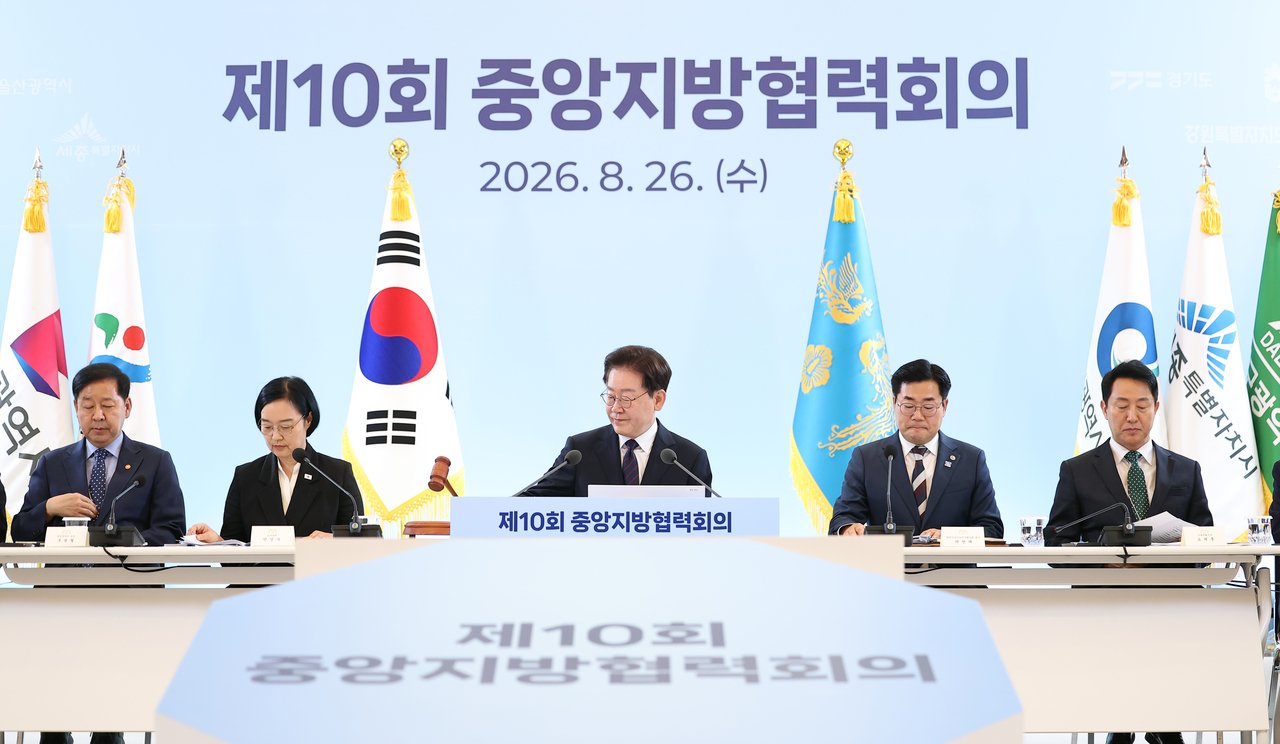
Local leaders brought a diverse slate of growth proposals to President Lee Jae Myung on Wednesday, from renewable energy projects along the inter-Korean border to building a K-food hub in North Gyeongsang Province.
The pitches came as Lee’s administration seeks to channel investment, industries and jobs beyond the capital region and build new regional economic hubs around strategic industries.
Lee chaired the 10th central-local cooperation meeting at Cheong Wa Dae in Seoul, the first since the June 3 local elections, bringing together newly elected mayors and provincial governors with central government officials to strengthen cooperation and advance the administration’s regional development agenda.
“Balanced development is no longer a choice or a favor, but an essential strategy for the survival and sustainable growth of the Republic of Korea,” Lee said during the meeting, referring to South Korea by its official name.
Lee called for greater resident participation, stronger cooperation among local governments and faster administrative innovation.
Lee further pledged to diversify strategic industries through three major megaprojects focused on semiconductors, pharmaceuticals and artificial intelligence, including AI data centers, while advancing a regional development strategy built around five major regional blocs and three special autonomous provinces.
The governors brought that broader strategy down to the local level, pitching projects aimed at turning regional strengths and long-standing obstacles into new sources of investment, jobs and growth.
Gangwon Province Gov. Woo Sang-ho highlighted plans to build a resident-participatory renewable energy base in inter-Korean border areas, according to a written briefing from senior presidential spokesperson Kang Yu-jung after the meeting.
But Woo said landmines across the border area remain a major obstacle, calling on the central government to take responsibility for clearing them.
“The question is who will remove the landmines and who will bear the cost,” Woo said, urging the Ministry of National Defense to support the effort.
Woo also pointed to the prospect of SK investment in Gangwon Province as a potential catalyst for young people in the province.
“Since SK promised to come to Gangwon, the eyes of young people in Gangwon are shining,” Woo said.
Woo said the province had agreed with local university presidents to develop industry-specific talent, linking corporate investment with education and jobs.
North Gyeongsang Province Gov. Lee Cheol-woo, meanwhile, mixed a political joke with a pitch for the province’s next growth industry, according to Kang.
“South Jeolla seems likely to do well because it elected the president, but presidents from our region don’t do much for us even when we elect them,” Gov. Lee said, drawing laughter from the room.
The remark came as South Jeolla Province, which recently merged into Jeonnam-Gwangju, is expected to benefit from major government investment through the Lee administration’s three megaprojects.
Gov. Lee then pitched food as a growth industry, saying North Gyeongsang Province plans to leverage its rich agricultural base to develop a K-food industry and urging the government to consider the province if the Korea Food Promotion Institute is relocated outside the capital.
“In an era of the Fourth Industrial Revolution, when machines do the work instead of people, what people will do is the food industry,” he said.
Gov. Lee also urged the government to “consider North Gyeongsang” if the Korea Food Promotion Institute is relocated outside Seoul.
Kang further explained that the meeting laid out the broader framework for the regional-growth push.
The government plans to identify three to four growth engines in each major region and concentrate financial, tax, technological, talent and infrastructure support on them, Kang said in the written briefing following the meeting.
Investment will also focus on regional strategic industries and jobs, healthcare, education and living conditions, with greater autonomy for local governments, Kang added.
At the close of the meeting, Lee returned to the central goal of reducing the country’s dependence on the Seoul metropolitan area, according to Kang.
“The most powerful means of resolving the problems caused by concentration in the Seoul metropolitan area is ultimately strengthening decentralization and achieving balanced regional development,” Lee said.