
 KB News Desk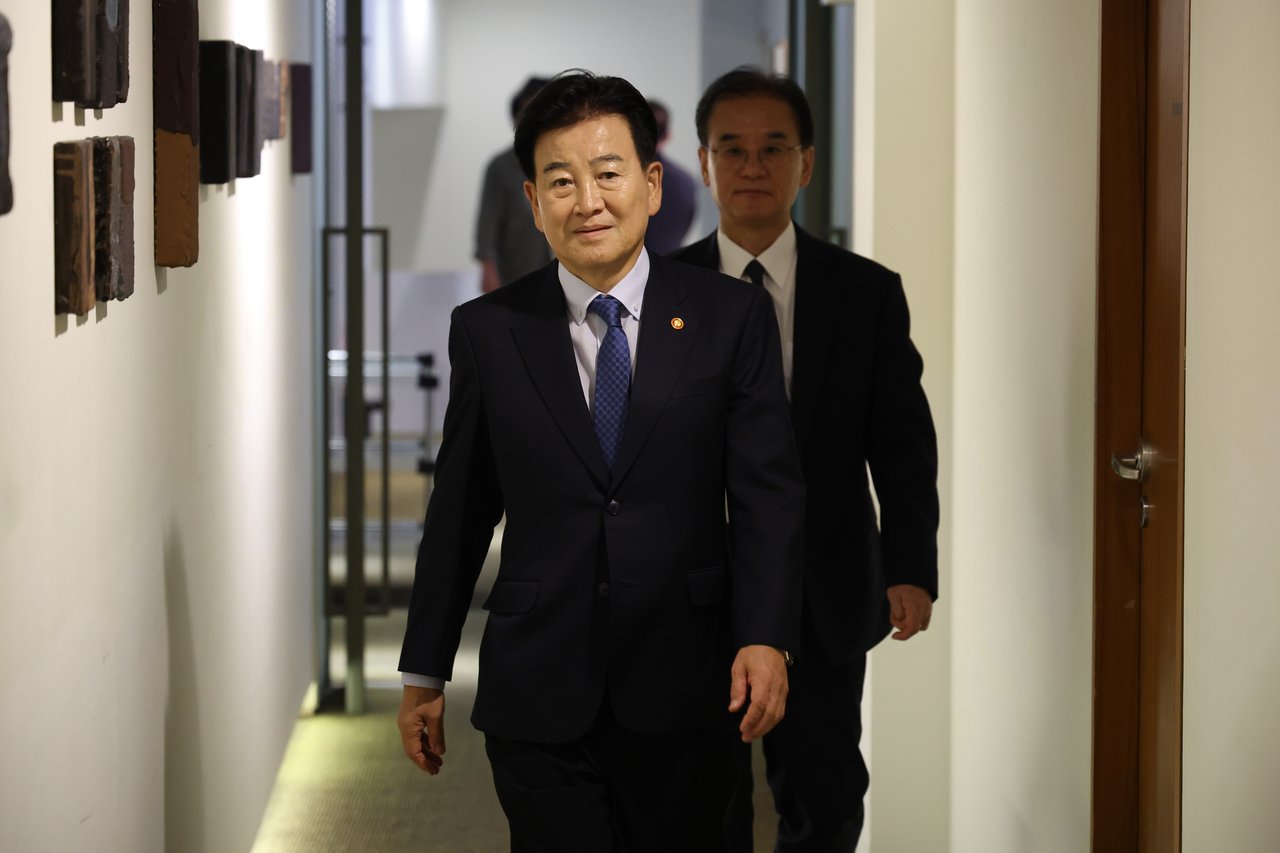
South Korea’s Unification Ministry on Friday said restarting US-North Korea dialogue and first halting Pyongyang’s expanding nuclear capabilities is the most realistic way forward, pushing back against concerns that US President Donald Trump’s latest overtures could leave Seoul sidelined or amount to tacit acceptance of North Korea’s nuclear arsenal.
A senior ministry official said that with North Korea continuing to expand its nuclear capabilities and inter-Korean relations at a standstill, renewed talks between Washington and Pyongyang offer the only viable option for changing the current trajectory.
“North Korea’s nuclear capabilities are continuing to grow even at this very moment, while inter-Korean relations remain blocked. What other driving force is there to move this issue forward besides the resumption of US-North Korea dialogue?” the official told reporters, requesting anonymity.
“Through US-North Korea dialogue, a broader initiative could begin to address the fundamental issue and seek to transform the unstable armistice system on the Korean Peninsula,” the official said.
The remarks come as Trump has stepped up signals of his willingness to reengage North Korean leader Kim Jong-un, fueling both expectations of renewed diplomacy and concerns in Seoul that Washington could prioritize reducing threats to the US mainland while leaving North Korea’s shorter-range nuclear threat to South Korea largely untouched.
The official cautioned against focusing on the prospect of South Korea being excluded from possible US-North Korea negotiations — a concern often referred to here as “Korea passing” — arguing that the immediate priority should instead be creating momentum to halt the North’s nuclear buildup.
The official interpreted Trump’s recent decision to scale back South Korea-US combined military exercises and his reluctance to publicly emphasize denuclearization as a “precise response” to conditions for dialogue laid out by Kim at the ninth congress of the ruling Workers’ Party in February.
Kim had demanded that Washington recognize North Korea as a nuclear-armed state and abandon what Pyongyang calls its “hostile policy” toward the North, according to the official.
“President Trump has sent signals on those two points,” the official said.
The official also suggested that Pyongyang has strong incentives of its own to return to negotiations with Washington.
“North Korea has said it will not meet President Trump if denuclearization is on the table, so if dialogue does take place, it would amount, even if only by force of circumstances, to North Korea gaining some form of recognition of its nuclear possession,” the official said.
At the same time, the official acknowledged concerns that an approach focused initially on freezing North Korea’s nuclear capabilities could be seen as effectively tolerating its existing arsenal.
But the official emphasized that stopping further nuclear development must precede any longer-term effort to roll back the program.
“The nuclear car is speeding ahead. You have to make it stop first before you can put it in reverse. You cannot reverse while it is still moving,” the official said.
“Just as North Korea’s nuclear program has developed over a long period, the process of moving toward a nuclear-free Korean Peninsula will inevitably take a long time,” the official added. “I hope the focus will be placed on halting the nuclear program rather than on whether we are tolerating North Korea’s nuclear weapons.”
Asked about the possibility that future negotiations could end without adequately addressing North Korea’s nuclear threat against South Korea, the official said issues including arms control would need to be addressed as part of negotiations toward a broader peace regime on the Korean Peninsula.
The official did not, however, elaborate on how Seoul could ensure that its security concerns would be reflected in potential negotiations between Washington and Pyongyang.
The ministry’s assessment came against the backdrop of another sharp rebuke from Pyongyang.
Kim Yo-jong, a department director of North Korea’s ruling Workers’ Party and the influential sister of Kim Jong-un, issued a statement Thursday criticizing President Lee Jae Myung by name and ridiculing Seoul over the reduction of the allies’ Ulchi Freedom Shield exercise, which ends Friday following Trump’s order to reduce the drill from 11 days to five.
Earlier Thursday, North Korea fired multiple short-range ballistic missiles toward the East Sea, even as Trump continued to signal his willingness to resume engagement with Pyongyang.
Kim Yo-jong said Trump’s order to reduce the scale of the exercise had placed Seoul “in a poor plight of canceling ‘war games’ it liked very much,” and described the reduction as “an evident disaster” for South Korean authorities that had been “blinded by their firm belief in the US master.”
The senior Unification Ministry official took issue with Kim Yo-jong’s rhetoric, saying mutual respect should accompany Pyongyang’s stated aspirations to behave as a “normal state.”
“The key to the process of becoming a normal state is consideration and respect for the other side,” the official said.
“Peace and stability on the Korean Peninsula, peaceful coexistence and a peace regime require South and North Korea to look in the same direction. In that respect, there should be no disparagement or distortion.”
The Unification Ministry separately urged Pyongyang not to misrepresent Seoul’s peace overtures, while stressing that the government would not change course in response to individual North Korean statements.
“We urge the North not to distort our commitment to peace on the Korean Peninsula and to join us in the journey of transforming the unstable armistice system into a peace regime for the benefit and security of both South and North Korea,” it said.
Unification Minister Chung Dong-young, meanwhile, suggested that the recent flurry of diplomatic signals could point to broader changes in the regional landscape.
“It is still too early to make predictions, but I feel that it is not merely an ember beginning to stir. The tectonic plates of Northeast Asia are shifting,” Chung told reporters.