
 KB News Desk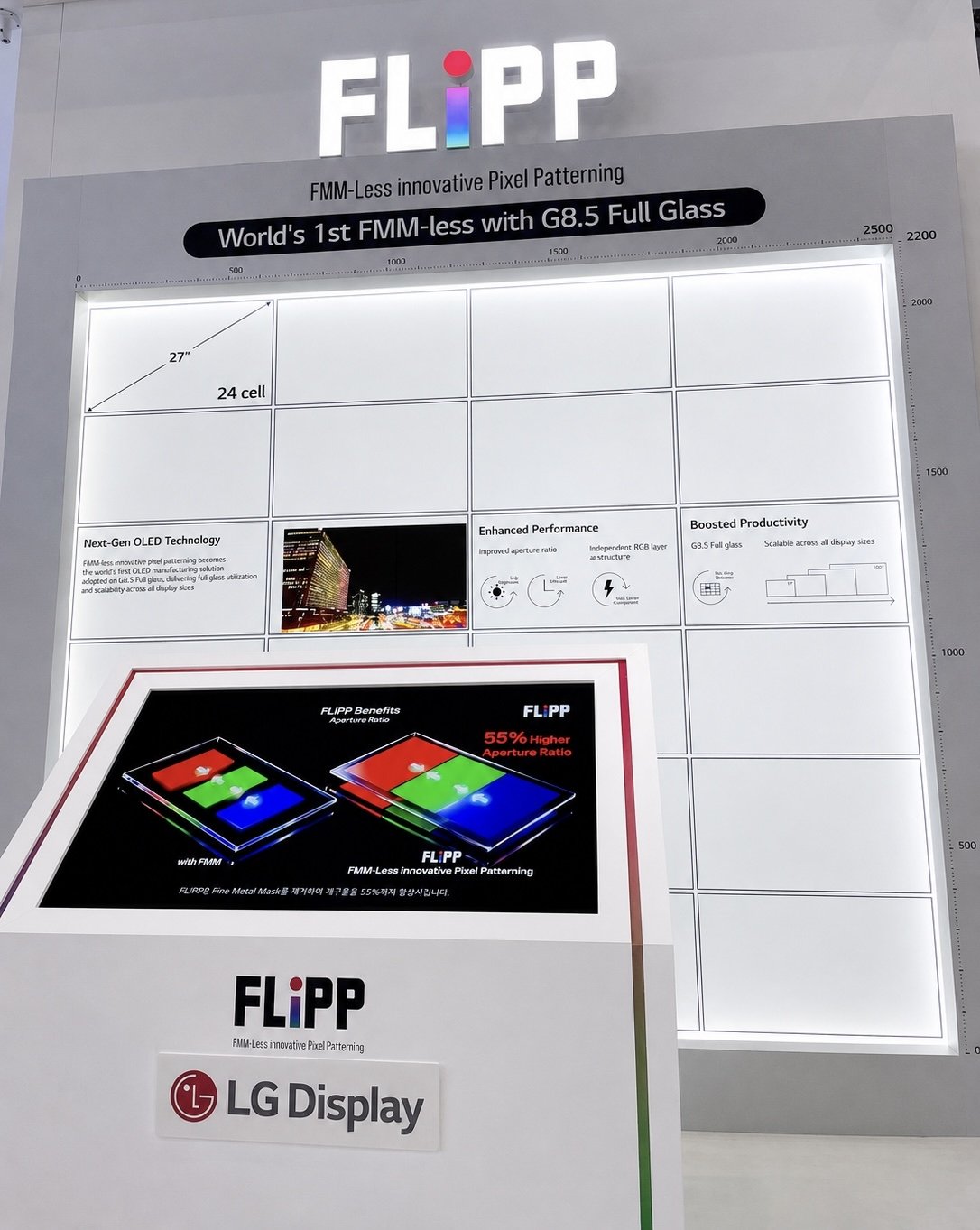
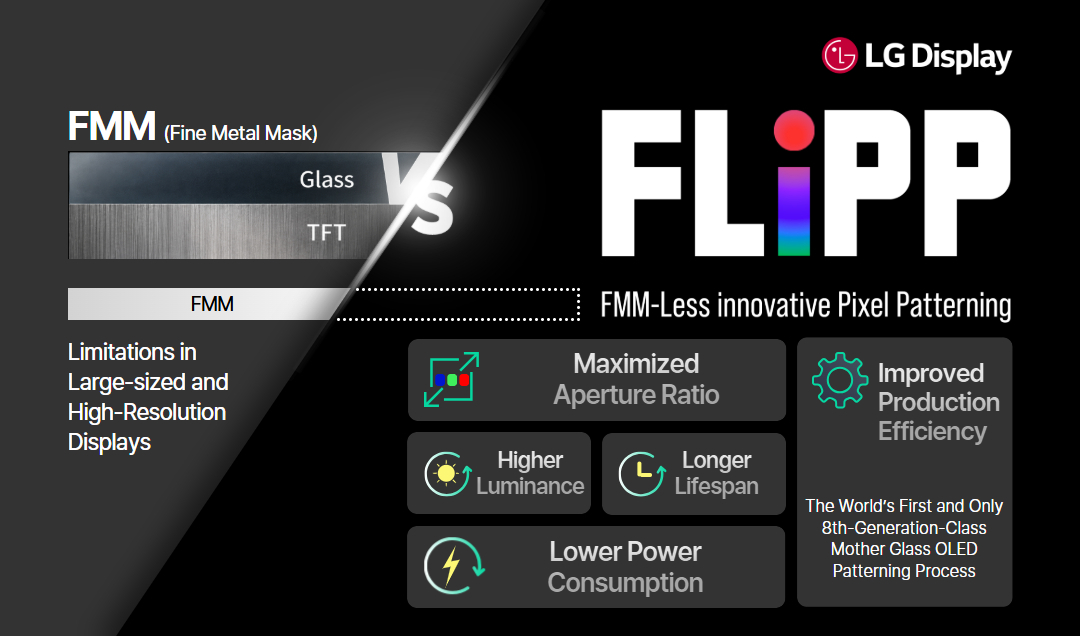
LG Display on Wednesday unveiled a new OLED manufacturing technology that eliminates the fine metal masks used to form red, green and blue pixels, allowing brighter, longer-lasting displays with lower power consumption.
The Korean panel-maker said Flipp — FMM-less innovative pixel patterning — is the world’s first technology to produce mask-free organic light-emitting diode panels on a full 8.5-generation glass substrate.
LG Display introduced the technology at IMID 2026, a major display conference in Busan.
Conventional OLED production uses fine metal masks, or FMMs, to deposit RGB organic materials through microscopic openings. But larger masks can sag under their own weight, causing alignment errors, while new masks must be produced whenever panel sizes or resolutions change.
Flipp instead deposits RGB materials onto the substrate and uses a photolithography-based process involving ultraviolet light to remove unwanted areas and form pixels.
LG Display said the process increases the aperture ratio, or the share of the display area occupied by active pixels, by about 55 percent compared to the conventional FMM method.
Depending on panel design, Flipp can increase brightness by up to 1.6 times, extend lifespan by 2.4 times or reduce power consumption by 13 percent, the company said.
It also allows an entire 8.5-generation mother glass substrate to be processed without cutting it into smaller sections, improving glass utilization by up to 64 percent.
LG Display said the technology could be applied to displays ranging from 1 inch to 100 inches, starting with products such as tablets and laptops before expanding to wearables, TVs and virtual- and augmented-reality devices.
“We were able to successfully realize Flipp, a next-generation OLED patterning technology referred to as a ‘dream technology,’ by bringing together our proprietary WOLED technologies and know-how,” LG Display Chief Technology Officer Choi Young-seok said.
LG Display also won IMID’s award for display of the year for its Hyper Double Scanning technology, which raises OLED TV panel refresh rates from 144 to 165 hertz.