
 KB News Desk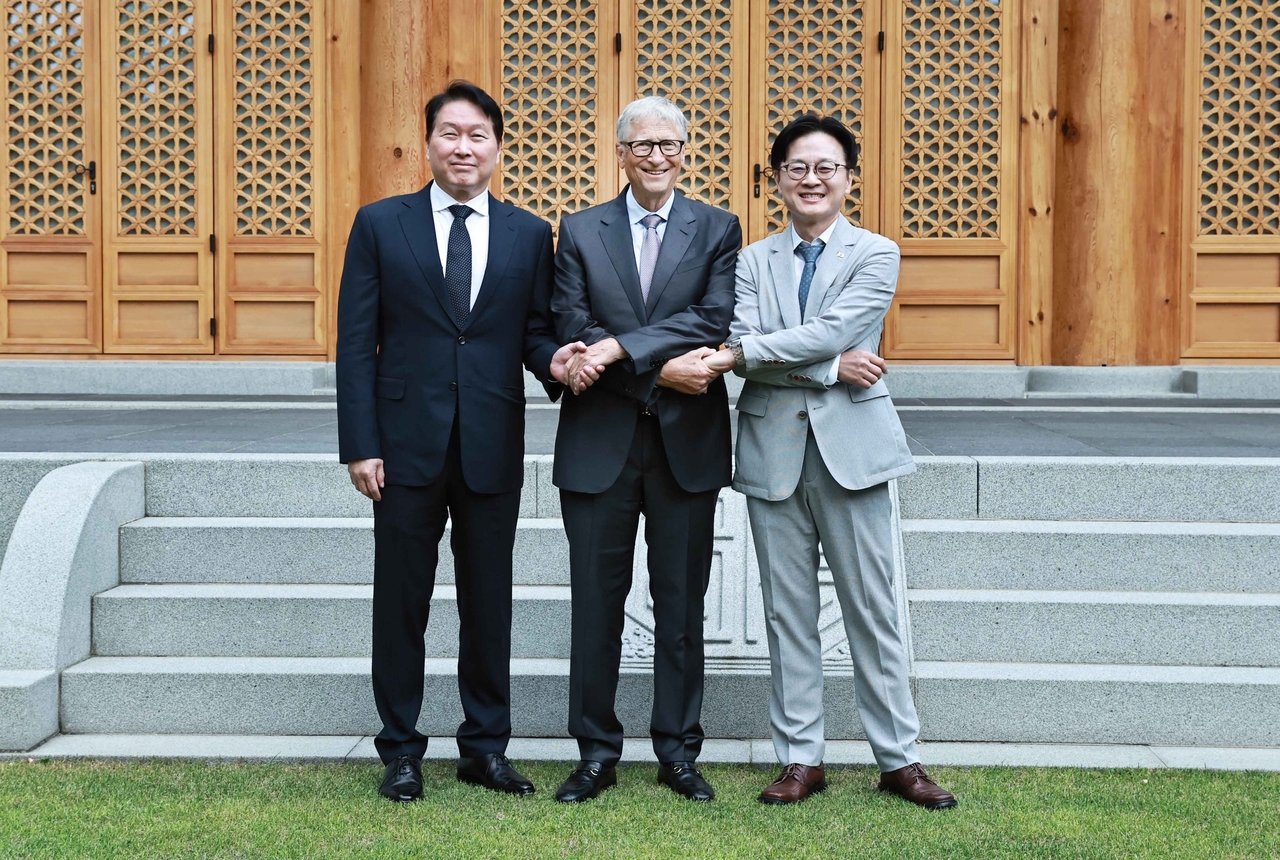
TerraPower deals deepen Korean role in global supply chain, but homegrown technology remains key to leadership
Bill Gates’ latest trip to Seoul has drawn attention to a potentially bigger role for South Korea in the fast-growing global market for small modular reactors.
During his visit last week, the TerraPower founder met senior government officials and the heads of SK Group and HD Hyundai. TerraPower also signed a series of new agreements that pulled Korean firms deeper into the US nuclear developer’s supply chain.
SK Innovation, South Korea’s largest refiner, signed a preliminary agreement to jointly pursue SMR projects in the US and other markets. Meanwhile, HD Hyundai and Doosan Enerbility inked deals to manufacture key reactor components for the Natrium project in Kemmerer, Wyoming.
The strings of agreement suggest that Korea could become one of the manufacturing centers of the global SMR industry as major developers are now moving from designing reactors to actually constructing them.
But can Korea become an SMR powerhouse in its own right?
Korea has already established itself as a strong manufacturing and construction partner for foreign reactor developers, drawing on decades of experience building conventional nuclear plants, massive shipyards and heavy-industry facilities.
But industry experts say the answer hinges on whether Korea can turn those manufacturing strengths into more than a supplier role.
Becoming a global powerhouse would require something more: commercially proven Korean reactor technology and the ability to produce a reactor that is easier to license, manufacture and deploy.
Why manufacturing matters for SMRs
SMRs are smaller nuclear reactors built from standardized components manufactured in factories and then assembled onsite, potentially shortening construction times and lowering upfront costs compared with conventional large reactors.
Surging electricity demand from artificial intelligence data centers has spurred interest in the technology in recent years. Tech companies are increasingly turning to nuclear power as a source of round-the-clock, reliable and low-carbon electricity, helping push SMRs from experimental projects toward commercial deployment.
That shift could play directly into Korea’s industrial strength.
The country is home to companies capable of producing massive nuclear forgings, reactor vessels and precision components. It also has shipbuilders skilled at assembling massive structures under strict standards, along with construction firms experienced in overseeing billion-dollar power projects.
“South Korea is one of very few countries that has those manufacturing and construction capabilities to turn a reactor design into an actual reactor,” said Moon Joo-hyun, a professor of energy engineering at Dankook University.
Moon said Korea’s edge lies in controlling construction time and costs, backed by decades of experience building large nuclear plants.
“For a nuclear power plant, construction time and cost are important as a large amount of capital has to be committed upfront,” he said. “Korea has accumulated experience completing projects on schedule and controlling cost, and that makes Korean partners attractive to reactor developers.”
The Korean government has made a similar pitch. Following Gates’ visit, the Industry Ministry described Korea as possessing a “foundry-scale” nuclear manufacturing ecosystem built through five decades of constructing and operating nuclear power plants.
The idea is that combining foreign reactor designs with Korea’s manufacturing capabilities could position Korean firms at the center of future SMR supply chains.
TerraPower taps Korean suppliers
That role is already taking shape through TerraPower.
Its Natrium plant is a 345-megawatt sodium-cooled fast reactor with molten-salt energy storage that can temporarily increase output to 500 megawatts. The US Nuclear Regulatory Commission approved construction of TerraPower’s Kemmerer plant in March, marking the first US commercial reactor construction approval in nearly a decade and the first for a nonlight-water reactor in more than 40 years. Construction began in April and is targeted for completion in 2030.
Korean companies have worked to build ties with the plant.
SK Inc. and SK Innovation invested a combined $250 million in TerraPower in 2022, becoming the company’s second-largest shareholder after Gates. Under the latest agreement, SK Innovation could participate in TerraPower projects in the US and other countries, while the companies will also examine the possibility of deploying Natrium technology in Korea.
HD Hyundai Group’s role is more manufacturing-focused, leveraging its shipbuilding expertise.
The shipbuilder invested $30 million in TerraPower in 2022 and was later designated as the preferred bidder to manufacture and supply core equipment for the Natrium project. HD Hyundai plans to accelerate investments in its production, targeting an annual supply capacity of two to three reactor vessels.
Doosan Enerbility, Korea’s largest nuclear equipment manufacturer, has also deepened ties with TerraPower. It signed the agreement last week to supply core structural components, including the containment vessel, support framing and internal reactor structures, for the Natrium plant.
Doosan is not just tied to TerraPower; it has secured a reservation agreement with US developer X-energy for major steel components, including reactor pressure vessels and steam-generator pressure vessels, for the first 16 Xe-100 reactors.
The company has also invested more than $100 million in Nuscale Power. It has produced long-lead materials for the US developer and is preparing to manufacture key reactor-module components for Nuscale’s SMR plants.
In May, Britain’s Rolls-Royce SMR selected Doosan as a strategic supplier for key components, including work related to reactor pressure vessels for projects in the UK and the Czech Republic.
Hyundai Engineering & Construction also secured an agreement with TerraPower last week to undertake engineering, procurement and construction work for as many as eight Natrium reactors.
Korea’s homegrown SMR
Participating in foreign SMR projects does not automatically make South Korea a technology leader, experts say.
For many of the projects in which Korean companies are participating, the core reactor technology and intellectual property belong to foreign developers such as TerraPower, X-energy and Rolls-Royce SMR.
That raises a long-term question on the sustainability of Korea’s SMR manufacturing edge.
That is why Korea is simultaneously pursuing a second strategy: developing SMR technology of its own.
The government-led innovative SMR, or i-SMR, project applied for standard design approval in February. Korea’s Nuclear Safety and Security Commission has begun a dedicated review process for the reactor as the government seeks to move toward commercial deployment.
The government’s newly announced seven “SEED” initiative further raises the stakes.
Under the strategy announced last week, Seoul designated SMRs as one of seven key technologies to cultivate as future growth engines. The government aims to commercially deploy homegrown water-cooled i-SMRs by 2035, while beginning construction of nonwater-cooled advanced reactors around 2030.
Moon said combining overseas partnerships with development and deployment of Korea’s own reactors is necessary to keep the country’s nuclear industry competitive.
“We ultimately have to pursue a two-track strategy,” said Moon.
“If Korea does not build projects at home and relies only on overseas projects, there is too much uncertainty,” he added. “That would make the domestic industrial ecosystem unstable.”