
 KB News Desk
Support for pet bereavement leave exposes a generational divide over pets, grief and workplace benefits
For many pet owners, losing a companion animal can feel like losing a family member. But whether that grief should be recognized at work remains a divisive question in South Korea.
A small but growing number of companies now offer pet bereavement leave, reflecting the rise of pets as family members. But the idea remains controversial, exposing a gap between changing household realities and workplace benefits still largely built around marriage, childbirth and childcare.
As of 2026, only a handful of companies allow employees to take leave when their pets die. Lotte Department Store made headlines in 2022 when it became the first major Korean conglomerate to offer one day of leave for a pet funeral. Gowoonsesang Cosmetics adopted a similar system in 2024.
Lush Korea has offered one day of pet bereavement leave since before 2020. It also provides a monthly pet ownership allowance of 50,000 won ($32) to single employees who have worked at the company for at least five years.
These benefits are offered at the company level and are not mandated by law. While Korea has expanded parental leave and childbirth-related benefits in an effort to address its low fertility rate, workplace support for single employees or those living with pets remains limited.
Legislative move falls short
In August 2022, Rep. Lee Yong-sun of the ruling Democratic Party of Korea proposed a legal revision that would have granted pet owners up to five days of leave when their pets fell ill or died.
The proposal was intended to reflect changing perceptions of pets, as more Koreans regard companion animals as family members.
Around 29.2 percent of households in Korea had pets in 2025, the highest figure on record, according to a survey by the Ministry of Agriculture, Food and Rural Affairs. Dogs and cats accounted for most pets, though some households also kept fish, birds, rodents, reptiles and other animals.
Lee and nine other lawmakers withdrew the proposal after facing strong opposition from some members of the public. Many of the roughly 7,700 comments posted on the National Assembly website argued that the measure would be unfair to people without pets.
Pets as family
The debate comes as pet funerals are gradually becoming more common among pet owners in Korea.
Although dead companion animals are legally treated as waste, many owners find such treatment emotionally unacceptable and instead turn to funeral services or other memorial practices.
A 2025 government survey showed that 38.5 percent of pet owners buried their pets’ bodies in the ground, which is illegal because deceased animals are classified as waste, while 36.3 percent said they used pet funeral services. Another study by the KB Financial Research Institute in the same year showed that 64.6 percent of pet owners who lost their pets held a funeral for them.
For many owners, the death of a pet is a significant life event.
A study conducted last year by the College of Veterinary Medicine at Seoul National University found that 85 percent of people who lost their pets experienced emotional or psychological changes, and 79.1 percent said their perception of death changed.
Surveys also suggest that younger Koreans are more open to taking time off for pet funerals.
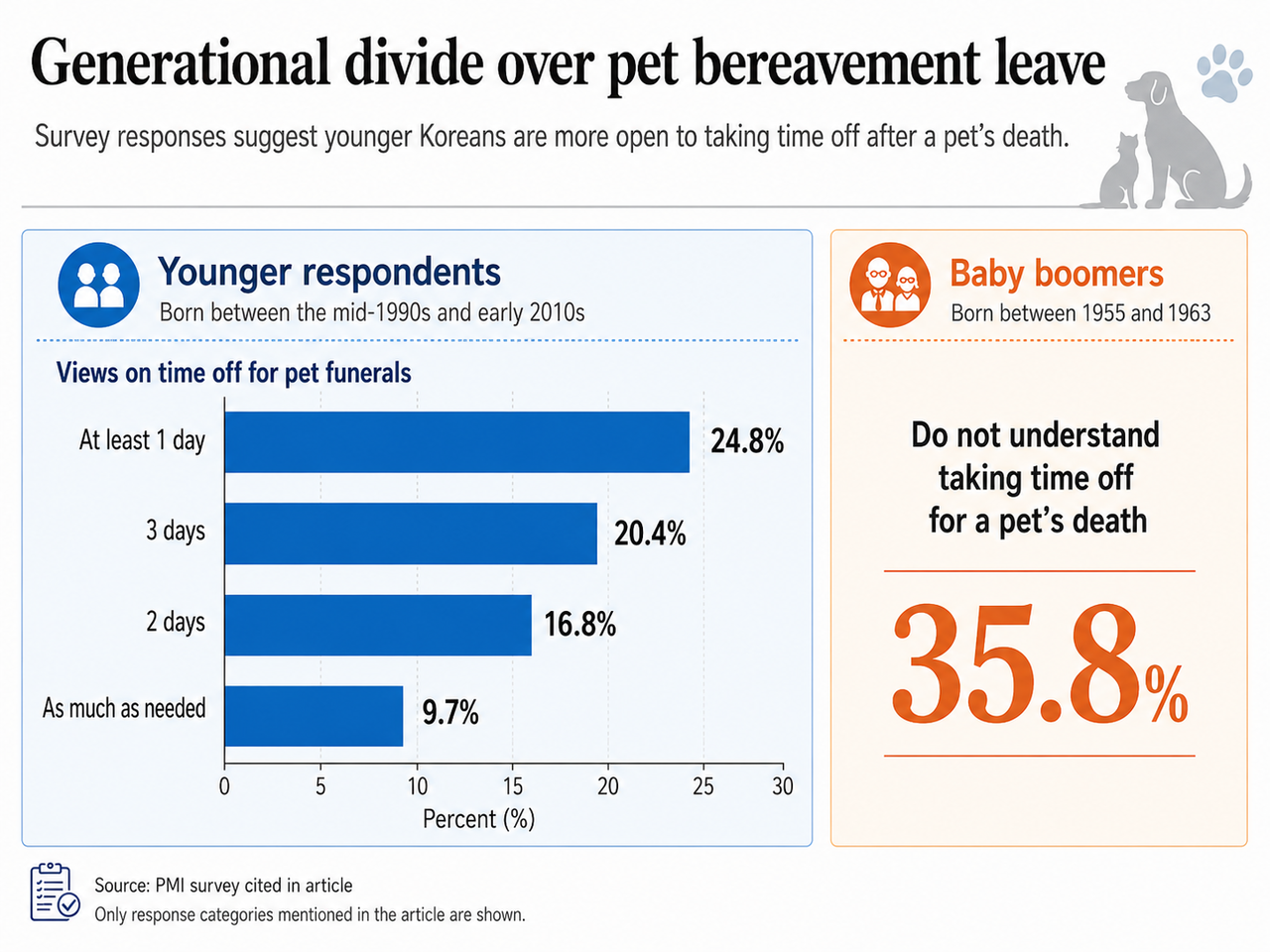
In a survey by consulting firm PMI, 24.8 percent of respondents born between the mid-1990s and early 2010s said workers should have at least one day to mourn the death of a pet. Another 20.4 percent said three days, 16.8 percent said two days, and 9.7 percent said workers should be allowed to take as much time as needed.
By contrast, 35.8 percent of baby boomers, defined as those born between 1955 and 1963, said they did not understand taking time off for a pet’s death, pointing to a significant generational gap in how Koreans view pets, grief and workplace benefits.