
 KB News Desk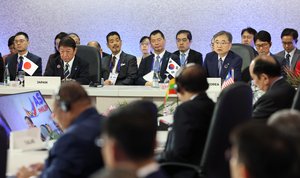
South Korea on Thursday called for stronger regional cooperation to bolster supply chain resilience and energy security while seeking continued support for the efforts to promote peace and stability on the Korean Peninsula at a gathering led by the Association of Southeast Asian Nations.
South Korean Foreign Minister Cho Hyun made the remarks during the 27th ASEAN Plus Three foreign ministers’ meeting in Manila, where he met counterparts from the 11 ASEAN member states, Japan and China to discuss regional cooperation, according to Seoul’s Foreign Ministry.
The talks took place as tensions around the Strait of Hormuz heightened concerns over the security of regional energy supplies and the resilience of global supply chains.
Cho said recent disruptions to shipping through the strategic waterway had exposed structural vulnerabilities in regional food and energy security, underscoring the need for stronger joint responses under the ASEAN Plus Three framework.
“There is a need to develop concrete forms of practical cooperation to diversify supply chains,” Cho said.
He said South Korea would contribute to the development of the ASEAN Power Grid, strengthen ASEAN’s capacity for the safe and peaceful use of nuclear energy and work with the International Energy Agency to reinforce the region’s energy security framework.
Cho also highlighted the ASEAN Plus Three framework’s track record in responding to regional crises through initiatives such as the Chiang Mai Initiative Multilateralisation and the ASEAN Plus Three Emergency Rice Reserve, saying the mechanism had produced tangible results since the Asian financial crisis and the COVID-19 pandemic.
He called for expanding cooperation in food security beyond rice and said the current challenges presented an opportunity for the group to demonstrate its value once again.
Cho also reaffirmed Seoul’s commitment to resuming dialogue with North Korea.
“The Republic of Korea will continue to make every effort to achieve peaceful coexistence and shared prosperity on the Korean Peninsula by resuming dialogue with the DPRK,” Cho said in his opening remarks, referring to North Korea by its official name, the Democratic People’s Republic of Korea.
“I am grateful for ASEAN Plus Three’s unwavering support for these efforts and look forward to further strengthening our cooperation in promoting peace and stability on the Korean Peninsula,” he added.
According to the Foreign Ministry, Cho also outlined the South Korean government’s efforts to achieve peaceful coexistence on the Korean Peninsula and expressed hope that participating countries would work together to promote lasting peace and sustainable prosperity across the region.
He said the countries shared the view that issues concerning the Korean Peninsula should be resolved through dialogue and diplomacy.
Japanese Foreign Minister Toshimitsu Motegi said the ASEAN Plus Three framework was playing an increasingly important role in addressing regional and global challenges, and called for greater cooperation on issues including energy and food security, aging populations and disaster prevention and response.
Chinese Vice Foreign Minister Hua Chunying, who represented Beijing in place of Foreign Minister Wang Yi, said the world had entered a period of turbulence and transformation, with geopolitical tensions weighing on energy and food supply chains as well as regional security and resilience.
Philippine Foreign Minister Ma. Theresa P. Lazaro, who chaired the meeting, said the dialogue platform remained highly relevant amid global uncertainty and called for renewed solidarity and collective action.
North Korea skipped this year’s ASEAN Regional Forum for the second consecutive year, despite it being the region’s only multilateral security forum that includes Pyongyang alongside the United States, China, Japan and Russia.