
 KB News Desk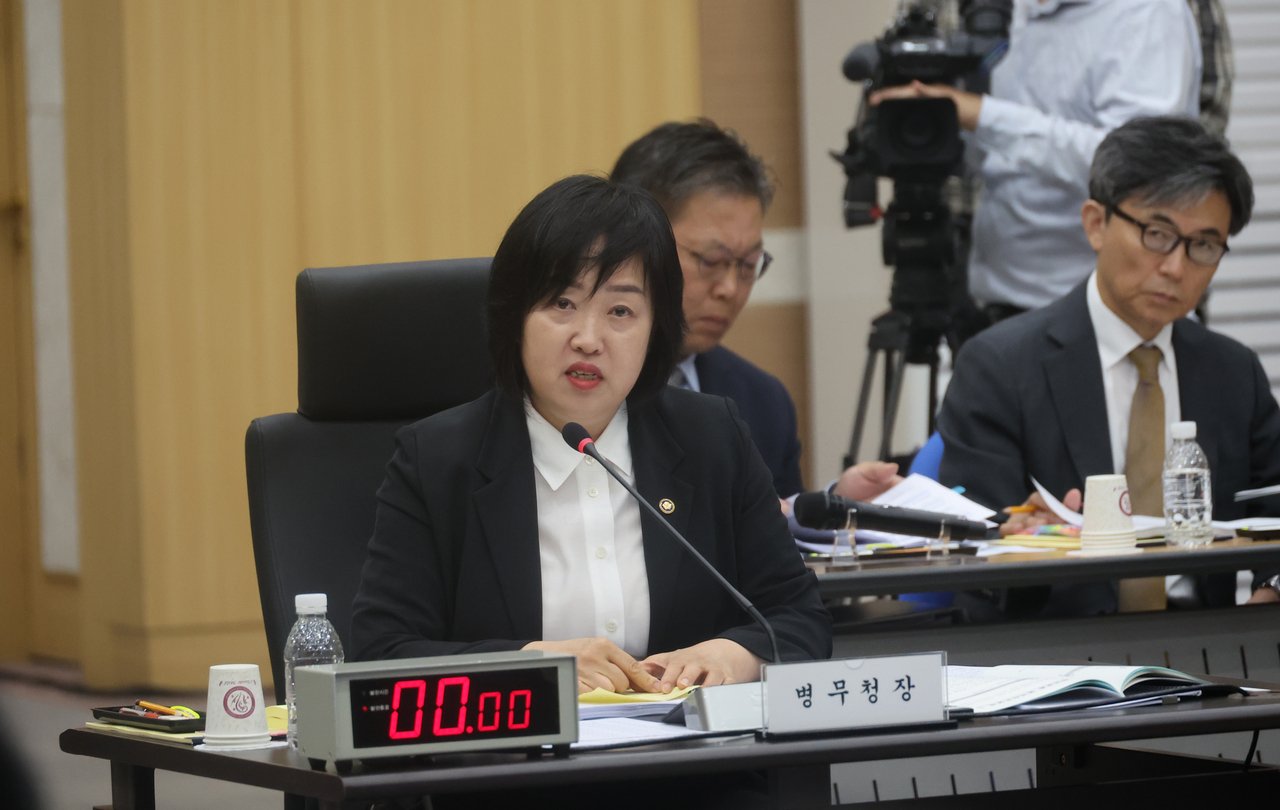
Military Manpower Administration Commissioner Hong So-young said Monday that the government is not considering mandatory military service for women, despite the steep decline in South Korea’s military numbers.
“The official position of both the Military Manpower Administration and the Defense Ministry is that we are not considering it at this point,” Hong said during a National Assembly National Defense Committee audit of the agency in Daejeon.
Hong said public consensus should come first, particularly as the decline in military-age men is expected to accelerate after 2040.
“Rather than suddenly introducing female conscription, the Defense Ministry and the Military Manpower Administration are gradually increasing the proportion of female officers and noncommissioned officers while building public consensus and preparing for the future,” she said.
The issue was raised by lawmakers from both the ruling and opposition blocs. Rep. Yoo Yeong-ha of the main opposition People Power Party called for formal discussion of female conscription, citing countries such as Denmark, Israel, Norway and Sweden as examples. Minor opposition Reform Party Rep. Chun Ha-ram urged consideration of what he called a “gender-neutral conscription system.”
According to data provided by the Military Manpower Administration, the number of men in their 20s — the core pool of potential conscripts — is projected to fall to about 143,000 in 2040 and around 120,000 by 2043, adding pressure on the military to secure enough personnel.
Hong added the agency would soon announce the results of its review of alternative service and military exemption programs, and confirmed it shares the Defense Ministry’s position that such programs should be gradually reduced and eventually abolished.
“We take seriously the sense of deprivation that young people currently fulfilling their military duties may have felt, as well as public calls for reform of the system,” Hong said.
She also expressed regret over remarks and actions by some South Korean athletes following the 2026 Aichi-Nagoya Asian Games that were criticized as trivializing mandatory military service.

South Korea’s men’s football team won the Asian Games gold medal after beating Japan 1-0 in the final on Oct. 3, securing the country’s fourth consecutive title in the event.
Team captain Lee Ki-hyuk said in a post-match interview, “I’m not going to the military,” while Yang Min-hyuk said securing a military service exemption had been a major motivation for him during the tournament. Another player, Park Seung-soo, drew criticism after posting a photo of himself wearing a military cap in the locker room.
Introduced in 1973 to promote national prestige, the system allows athletes who win an Olympic medal or an Asian Games gold medal to serve as athletic personnel after basic military training, rather than as regular active-duty troops.
The issue also surfaced during the Defense Ministry’s parliamentary audit last Wednesday, when lawmakers from both the ruling and opposition parties called for changes to the system.
Defense Minister Kang Shin-chul said the ministry aims to “gradually reduce military service exemptions and ultimately abolish them,” while expressing regret over remarks by some Asian Games athletes.
Meanwhile, Hong also said Monday former Defense Minister Ahn Gyu-back has not requested a correction to his military service records, despite previously indicating that he would seek to do so after leaving office.
Ahn had faced opposition accusations that he left his assigned post without authorization while serving as a short-term soldier, allegations the Defense Ministry rejected as false. The ministry said in July that Ahn planned to seek a correction of what it described as erroneous records after stepping down as minister.