

 KB News Desk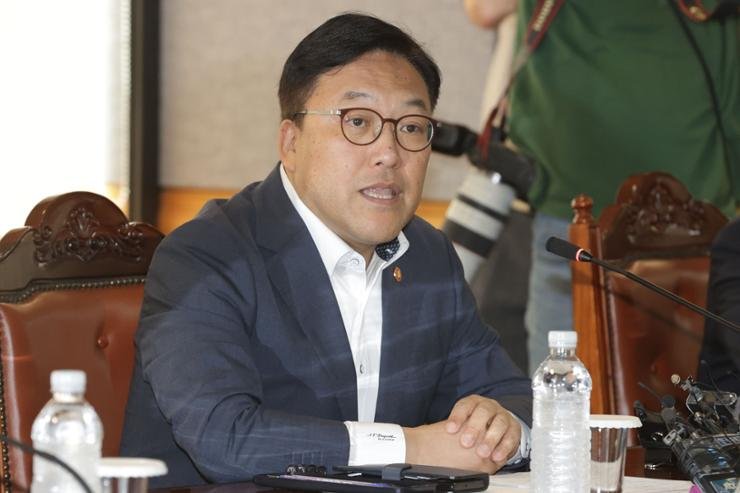
The country’s chief financial regulator said Tuesday that tightened curbs will be applied to mortgage loans starting next month in a bid to curb soaring household loans.
In a meeting with heads of local banks, Kim Byoung-hwan, the chief of the Financial Services Commission (FSC), said new mortgage borrowers will be able to take out loans smaller than before under the tightened criteria.
The stress debt service ratio (DSR), which measures how much a borrower has to pay for principal and interest in proportion to his or her yearly income, serves as a ceiling on aggregate lending.
Since February this year, the first-stage DSR has been applied to mortgages extended by banks.
Beginning in September, the more tightened DSR will be extended to mortgages issued by banks and non-banking financial institutions.
“The banking sector and the government need to take preemptive measures by raising their guard against increased debts in the first half,” Kim said, urging banks to establish their own tightened risk management system.
The chief regulator said the second-stage DSR will be more strictly applied to mortgages in the capital Seoul and the greater Seoul area where home prices have been soaring amid a tight supply.
According to the sources, the country’s top five lenders had already extended 4.18 trillion won ($3.14 billion) in household loans, mostly home-backed loans, in the first 14 days of this month.
Household loans extended by banks went up 5.5 trillion won in July, rising for the fourth consecutive month, led by a rise in mortgage loan growth, according to central bank data.
In the second quarter of the year, outstanding household credit reached 1,896.2 trillion won, up 13.8 trillion won from three months earlier, rebounding from the previous quarter’s 3.1 trillion-won fall, according to the central bank data.
Policymakers remained worried over a spike in household debts, which could sap further private spending.
Borrowing costs in Asia’s fourth-largest economy remain high following the BOK’s aggressive monetary tightening aimed at bringing surging inflation under control.
Last month, the central bank held its key interest rate steady at 3.5 percent for the 12th straight time amid moderating inflation and high household debt.
The rate freezes came after the BOK delivered seven consecutive rate hikes from April 2022 to January.
The central bank is widely expected to stand pat this week again. (Yonhap)