
 KB News Desk
Chairman Jang In-hwa unveils ‘triple-core’ strategy spanning steel, lithium and energy to strengthen Korea’s industrial supply chains
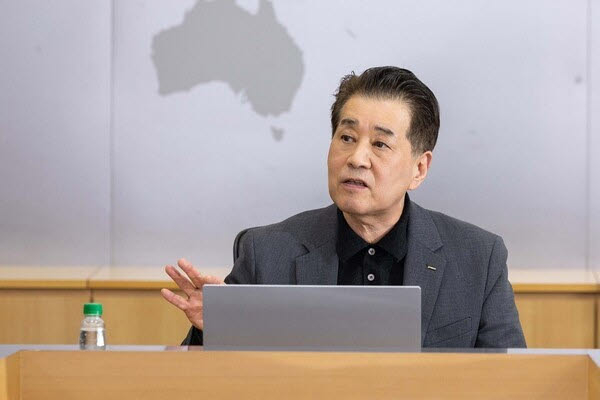
Posco Group Chairman Jang In-hwa on Wednesday unveiled a sweeping overhaul of the group’s business portfolio, pledging to transform the steelmaker into a “national champion supplier of strategic resources” spanning steel, lithium and energy.
Speaking directly to investors at the group’s CEO Investor Day event, Jang said rising geopolitical tensions, supply chain fragmentation and the accelerating shift toward low-carbon industries require a fundamental rethinking of corporate growth strategies.
“Now is the time to create new growth opportunities through bold innovation in our business portfolio amid growing external uncertainty driven by supply chain instability and the accelerating low-carbon transition,” Jang said.
“We will expand our business domain beyond steel and materials into resources and take the lead in strengthening Korea’s industrial security and supply chain resilience.”
The new strategy centers on what Posco calls a “triple-core” business structure encompassing industrial resources such as steel, strategic resources including lithium, rare earths and battery materials, and energy resources such as liquefied natural gas and renewable energy.
Under the vision, Posco aims to establish itself as Korea’s representative supplier of critical industrial resources while reducing its reliance on the cyclical steel business.
The group targets consolidated revenue of 187 trillion won ($120 billion) and operating profit of 13.1 trillion won by 2035.
Lithium emerged as the centerpiece of the investor presentation, reflecting growing investor interest as the group’s overseas projects begin to generate returns.
Posco plans to build an annual lithium production capacity of 173,000 metric tons by 2033 and become one of the world’s top five lithium producers. It expects the business to generate more than 1.8 trillion won in operating profit by 2035.
The company said its Argentine brine lithium operation turned profitable in March and recently secured approval under Argentina’s Large Investment Incentive Regime, strengthening the project’s economics and supporting plans to accelerate additional investment phases.
In Australia, Posco has secured more than 187,000 tons of lithium concentrate annually through a joint venture with Mineral Resources. The company expects stable annual profits of around 200 billion won from the project.
Beyond lithium, POSCO plans to expand into rare earths and specialty gases used in semiconductors, electric vehicles and robotics as part of its strategic resource portfolio.
Steel will remain a core pillar of the business, but future growth investment will increasingly target overseas markets such as India, the United States and Indonesia, where POSCO plans to expand production capacity by 10 million tons by 2031.
The profits generated from overseas growth projects will be reinvested into Korea’s low-carbon transition and domestic steel operations, the company said.
Energy has emerged as the third pillar of the group’s growth strategy. POSCO plans to expand LNG trading and enter renewable energy businesses, including offshore wind and overseas solar projects.
The group also said it plans to commercialize physical AI solutions for process industries by leveraging decades of automation expertise and operational data accumulated in its steel business. To support the transformation, Posco will invest 16.7 trillion won in future growth businesses between 2026 and 2028.
Separately, holding company Posco Holdings said it would seek to address the so-called holding company discount by optimizing its ownership stakes in listed subsidiaries to around 50 percent.
The company said capital secured through the restructuring would be redirected toward strategic resource investments managed directly by Posco Holdings, while roughly 10 percent of proceeds from asset sales would be used for share buybacks and cancellations to enhance shareholder value.
Posco plans to continue engaging with investors through additional CEO Investor Day events in Singapore on Sunday and Hong Kong next Tuesday.