

 KB News Desk
52 female divers protest outside construction firm in southern Seoul, claiming a harbor project cost them their livelihood
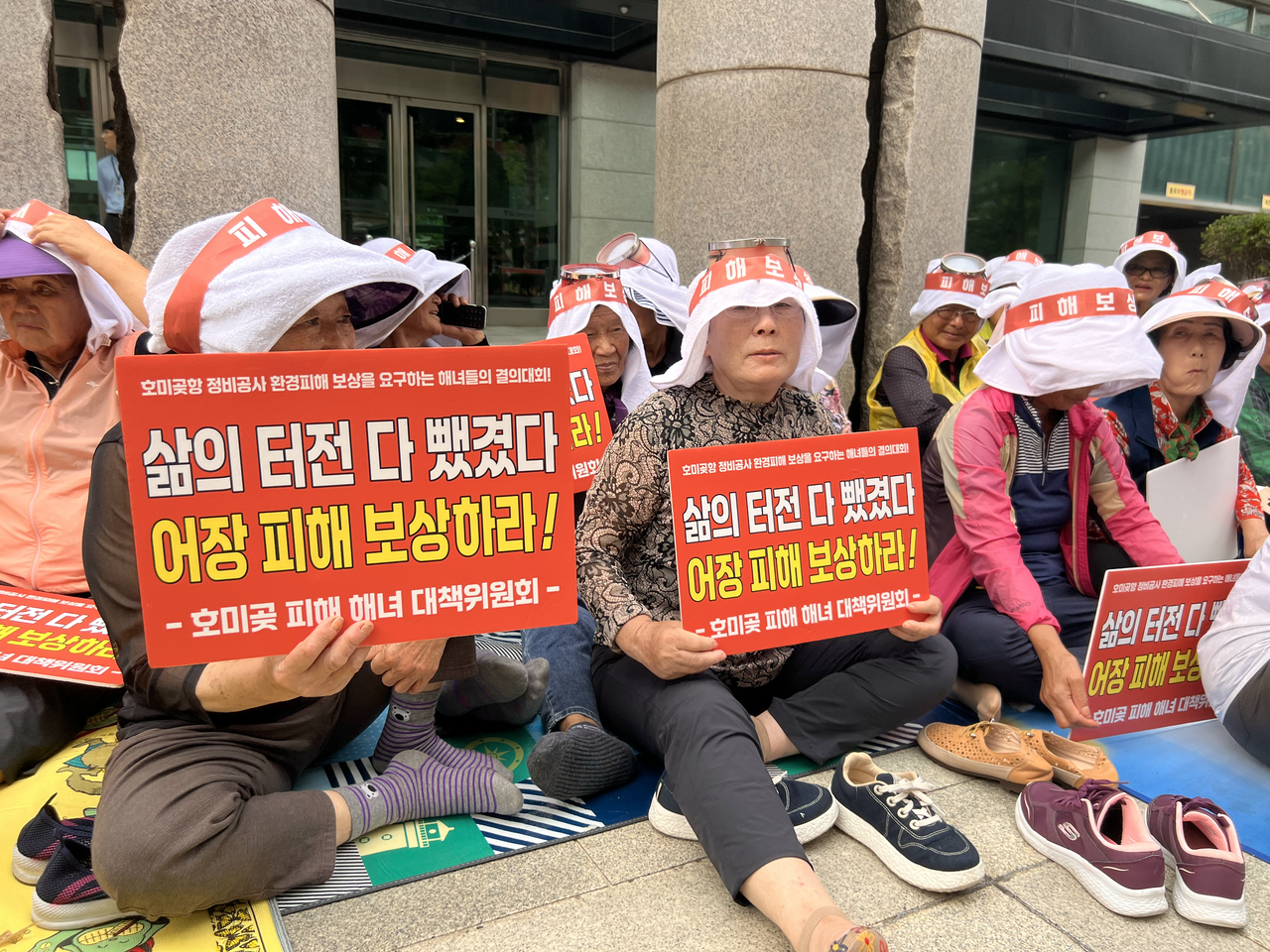
Under the scorching Tuesday morning sun, dozens of women sat shoulder to shoulder on mats outside a high-rise in Seoul’s Songpa-gu.
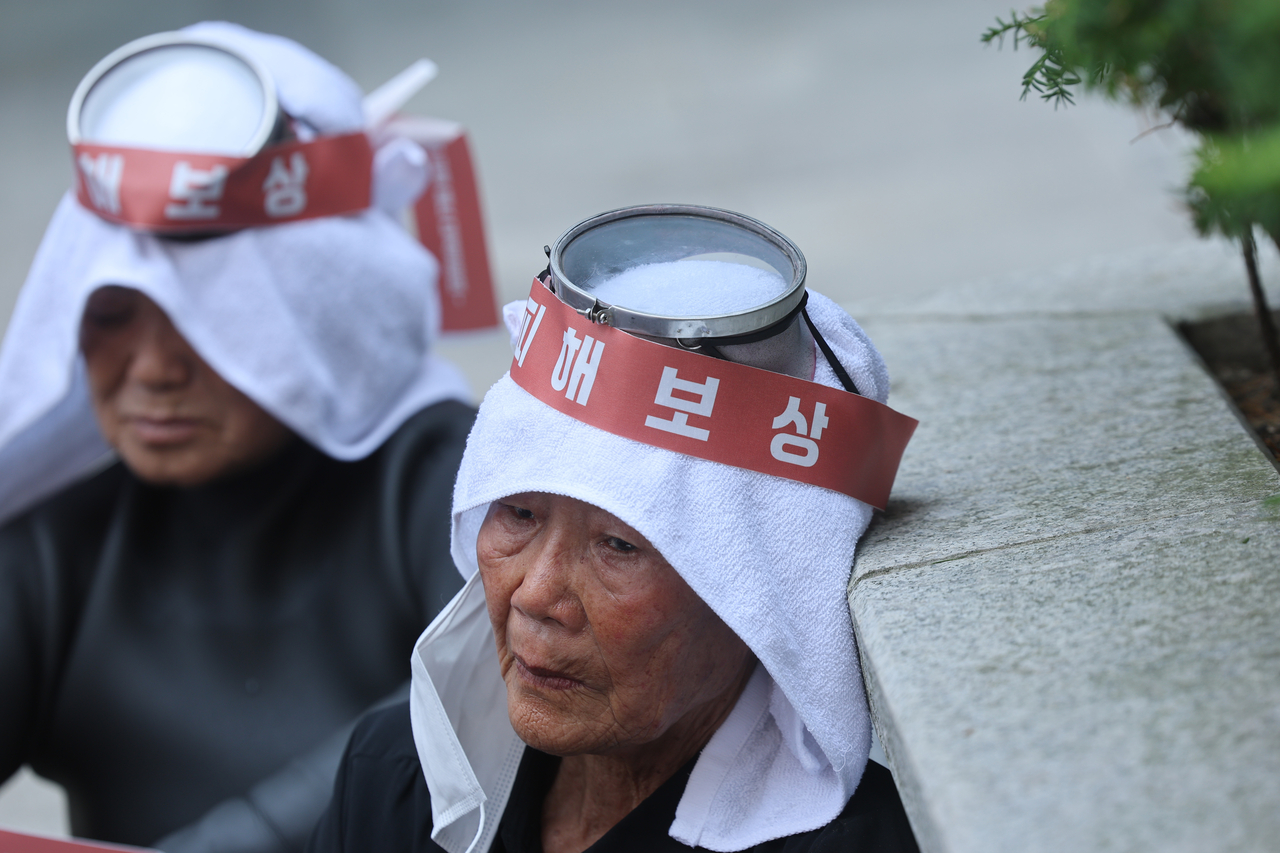
Some were in their 60s and 70s. Others were well into their 80s. All wore white towels on their heads and red headbands bearing the phrase “Damage compensation.” Some held signs that read: “Our livelihoods have been taken away. Compensate for the damage!”
The 52 women are haenyeo, Korea’s traditional female divers, who traveled more than 300 kilometers to Seoul from a fishing village in Homigot in the southeastern port city of Pohang, North Gyeongsang Province.
The divers claim that a five-year harbor renovation project devastated the sea they had relied on for decades. They were protesting in front of Ssangyong Engineering & Construction, which carried out the project.
‘Our sea is gone’
Tuesday marked the second and final day of their protest in Seoul.
“We’ve been diving for at least 40 to 50 years. The sea is our rice field, our farmland and our bank,” said Boo Soon-rok, 78, visibly fatigued by the heat.
On the first day of the protest, the women wore the black rubber diving suits traditionally worn by haenyeo, despite a daytime temperature of 33 degrees Celsius. By the second day, they had traded the heavy suits for everyday clothes.
Their orange tewak, the floating diving baskets they had carried from home, were lined up in front of them, a reminder of who the protesters were. Alongside the diving suit, the tewak is one of the most recognizable symbols of haenyeo.
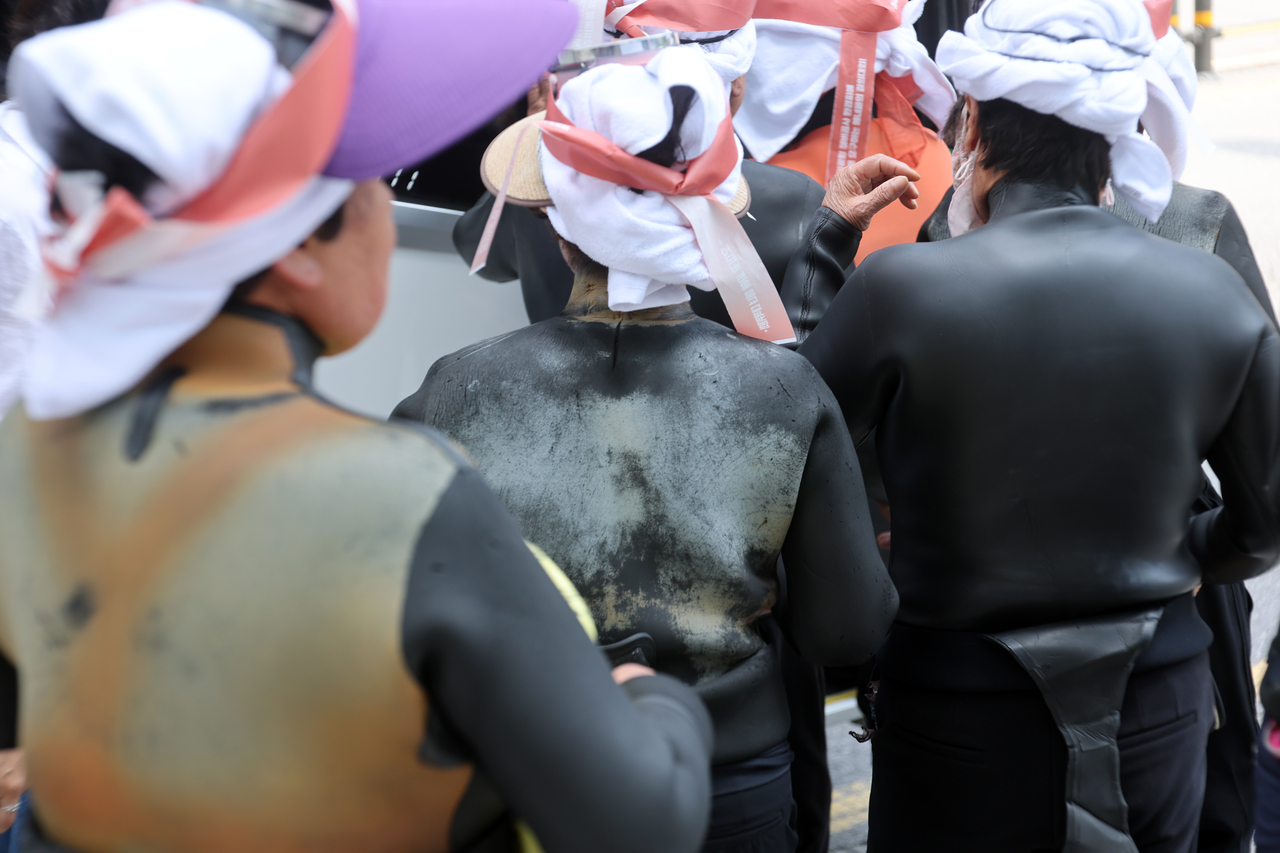
Boo said they left Homigot at 5 a.m. Monday and traveled to Seoul on two chartered buses. They planned to return home later Tuesday.
She recalled that a day’s dive once brought home enough seafood to buy rice and pay household bills. Those days, she said, are long gone.
“The ecosystem started to disappear when the construction began, and there’s almost nothing left,” she told The Korea Herald. “We are left wondering how we will support ourselves in the years ahead because we can’t ask our children for it.”
By “the construction,” she was referring to the Homigot Port renovation project, which ran from April 2021 to June 2026. Commissioned by the Pohang Regional Office of Oceans and Fisheries and carried out by Ssangyong E&C, the project involved dismantling and rebuilding aging breakwaters to improve the port’s infrastructure.
For Seo Chun-sun, 70, the dispute is about more than lawsuits and compensation. It is about the loss of a sea that had sustained generations of haenyeo.
Before the construction project, a day’s dive could bring in a harvest of as much as 10 kilograms, she said. Now, even on a good day, she returns with barely 2 kilograms.
“How are we supposed to live like this? We make our living from the sea, and if there is nothing to harvest, there is nothing to earn,” she said.
Seo said many of the women there were the primary breadwinners, earning much of the household income through diving while their husbands took on seasonal work or helped with fishing operations.
“Our husbands are jobless. We’re the ones who have to support our families. We should be out in the water making a living, but instead we’re here in Seoul protesting,” Seo lamented.
She believes repeated changes to the construction site, along with the rebuilding of breakwaters, disturbed the seabed, which she says damaged the rocky habitat where sea species once thrived.
“They didn’t move the construction just once,” she said. “They kept shifting it from one place to another. Every time they did, more of the seabed was damaged.”
Uphill battle
Although the divers hope their grievances are heard, an uphill battle still lies ahead.
Seo Na-hyun, 60, said the divers met with one of the company’s executives on Monday, but did not receive the response they had hoped for.
“We came here hoping to receive at least some compensation for what we have lost, or at least a blueprint of it. But the company told us there can be no compensation at all. That’s what makes us feel frustrated,” Seo said.
She said the compensation is needed to make up for the income the divers have lost.
“Before, we earned 1 million won ($646) a month and paid about 300,000 won in commission to the cooperative’s staff,” Seo explained, adding that the company had threatened the lives of many people in Homigot.
During the rally, Rep. Lee Sang-hwi of the main opposition People Power Party, which represents Pohang’s Nam-gu and Ulleung County, stopped to speak with the divers and meet with company officials.

Asked for comment, the politician had nothing much to say.
“You wouldn’t be here protesting if things had worked out. It’s a very complicated issue. I’ll think about what I can do to help resolve it,” he said.
If the deadlock persists, Seo warned that the divers will “keep fighting,” taking their protests to the National Assembly, Cheong Wa Dae, and the Ministry of Oceans and Fisheries until their voices are heard.
“The sooner the company comes to the table and discusses compensation with us, the easier it will be for everyone,” Seo said.
Boo said they are not asking for charity.
“We are asking to be compensated because we’ve lost our livelihood. If someone takes away your home or your means of making a living, they should take responsibility,” she said.
Many of the women now travel to neighboring fishing villages to continue diving, but Boo said those waters can never replace what they once had in Homigot.
“We can still earn something elsewhere. But it isn’t the same. This was our sea,” she said.