
 KB News Desk
Lee calls for expanded cooperation on critical minerals, infrastructure
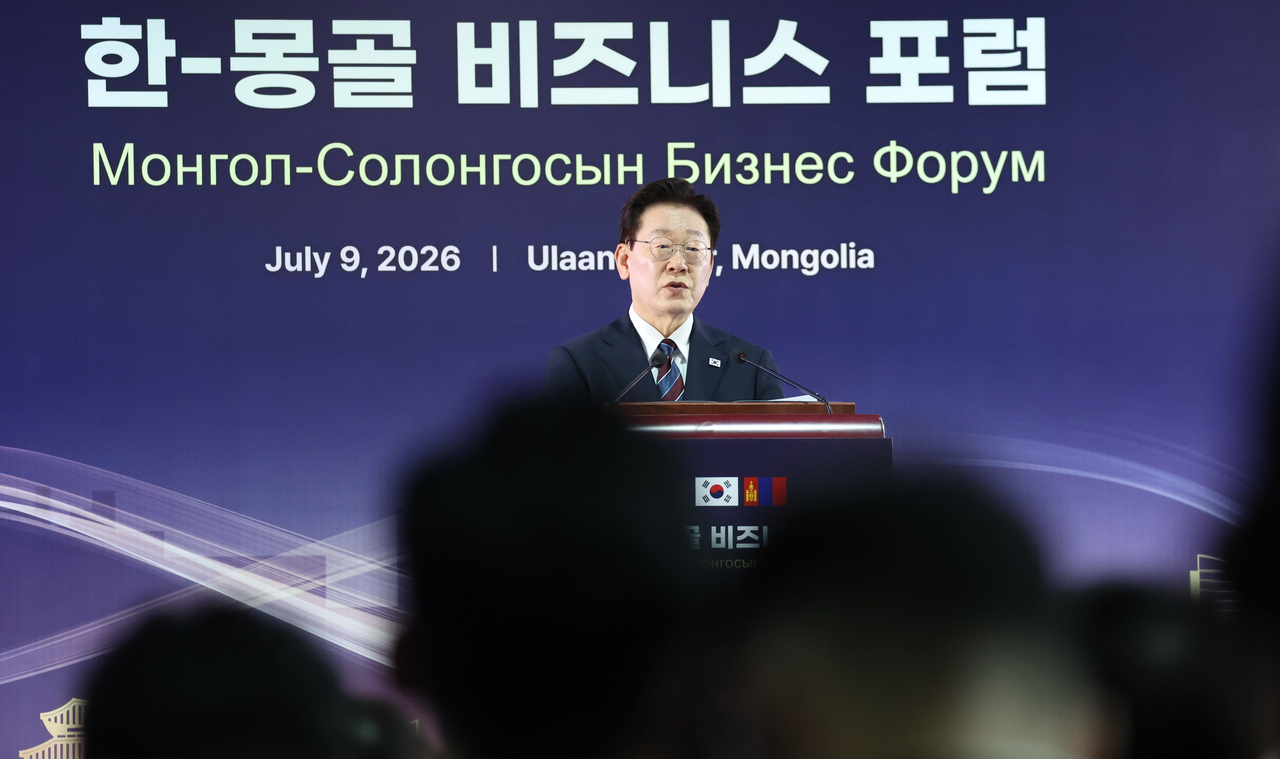
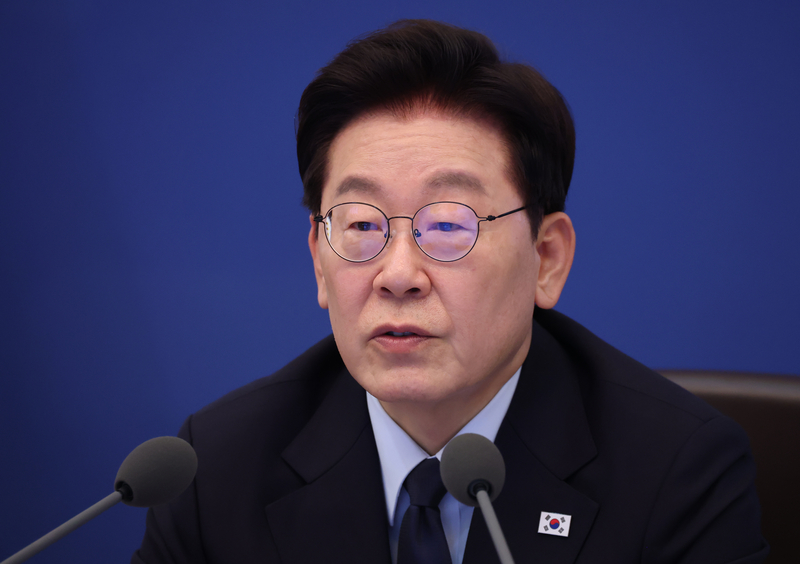
ULAANBAATAR, Mongolia — President Lee Jae Myung on Thursday called for expanding the “Mongtan” model of cooperation, saying it should serve as a blueprint for the next phase of Korea-Mongolia economic partnership.
Speaking at the Korea-Mongolia Business Forum, Lee highlighted “Mongtan,” a portmanteau of Mongolia and Dongtan, a rapidly developed and affluent satellite city south of Seoul that has become a nickname for Ulaanbaatar among some young Koreans.
“That speaks volumes about how easily one can find Korean convenience stores and hypermarkets here in Ulaanbaatar and how Korean cosmetics have become some of the most beloved products among Mongolian consumers,” Lee said.
“If I were to define ‘Mongtan’ in a single phrase, it is a model of mutually beneficial cooperation,” he added.
In this model, Lee explained, Korean retail and distribution companies provide technology and expertise, while Mongolian companies operate businesses through direct investment and accumulate experience.
“To further spread mutually beneficial models like Mongtan, we need to strengthen infrastructure, including joint logistics centers and cold chain systems, while expanding workforce development and technology exchanges,” Lee said.
Lee said he hoped that the memorandums of understanding signed on the sidelines of his summit with Mongolian President Ukhnaagiin Khurelsukh “will serve as a solid foundation for expanding this mutually beneficial model.”
The agreements covered a broad range of areas, including distribution and logistics, as well as cooperation on the development of Mongolia’s planned administrative capital, Kharkhorum.
“The ‘Mongtan’ model, which began in the retail and distribution sector, will now expand further into Korea-produced consumer goods such as food, beverages and cosmetics, and beyond that into a wide range of sectors including finance, healthcare, education and artificial intelligence,” Lee said.
“I hope we can further expand win-win models like Mongtan.”
Infrastructure, CEPA fuel growth
At the business forum, Lee further proposed that Seoul and Ulaanbaatar “create the foundation for joint growth in the fields of infrastructure investment and laws and institutions.”
Lee stressed the need for deeper infrastructure cooperation. He noted that Mongolia’s resource-driven economy has maintained annual growth of more than 5 percent, fueling growing demand for transportation, logistics and energy infrastructure.
“The Republic of Korea, equipped with world-class construction and engineering technologies and extensive experience in infrastructure development, is the ideal partner for the growth of Mongolia’s cities and industries,” Lee said, referring to South Korea by its official name.
South Korean companies are already involved in major urban development projects in Mongolia, including Ulaanbaatar Metro Line 1 — the country’s first urban railway project — and the city’s smart bus shelter initiative.
Lee stressed that Korea and Mongolia “must establish an institutional foundation that allows companies to trade and invest freely” if such cooperation is to expand further.
Against that backdrop, Lee said the Korea-Mongolia Comprehensive Economic Partnership Agreement, or CEPA, which was concluded in principle on Wednesday, will “become a new turning point in bilateral economic cooperation.”
“As barriers are lowered in goods, services and investment, I am confident that companies from both countries will be able to expand into new markets and business opportunities in a more stable and predictable environment,” Lee said.
“We will be able to bring forward the future of shared growth between our two countries by one step, particularly as trade and investment become more active in a wide range of sectors, including consumer goods, automobiles and pharmaceuticals.”
Critical minerals, shared strengths
At the forum, Lee also called on the two countries to “join forces as trusted partners in the critical minerals supply chain sector,” underscoring that Korea and Mongolia possess highly complementary strengths.
Mongolia is rich in critical minerals such as copper, molybdenum, tungsten and rare earth elements, while South Korea brings advanced technology, capital and logistics capabilities.
“If our two countries cooperate closely, we can generate clear synergies in the supply chain sector,” Lee said.
Lee pointed to the Rare Metals Cooperation Center, which opened in Ulaanbaatar last December, as a platform that can “serve as a key platform for cooperation and exchanges between companies from our two countries.”
The business forum followed Lee’s summit with Khurelsukh earlier in the day, during which the two leaders adopted a joint declaration aimed at opening what they called a “golden age” in Korea-Mongolia relations.
From the Korean side, major companies in sectors such as critical minerals, retail and consumer goods, and digital technologies participated, including LS, Posco, GS Retail, E-Mart and LG CNS.
From the Mongolian side, leading companies in the mining, retail and finance sectors attended, including MCS Group, Tavan Bogd Group and MAK, or Mongolyn Alt Group.
“The two countries each have distinct strengths in different areas — from resources and technology to human resources and capital — making the potential for bilateral cooperation even more limitless,” Lee said.
“I hope that this gathering serves as a meaningful starting point for ushering in a new golden age of relations between our two countries,” Lee added.