
 KB News Desk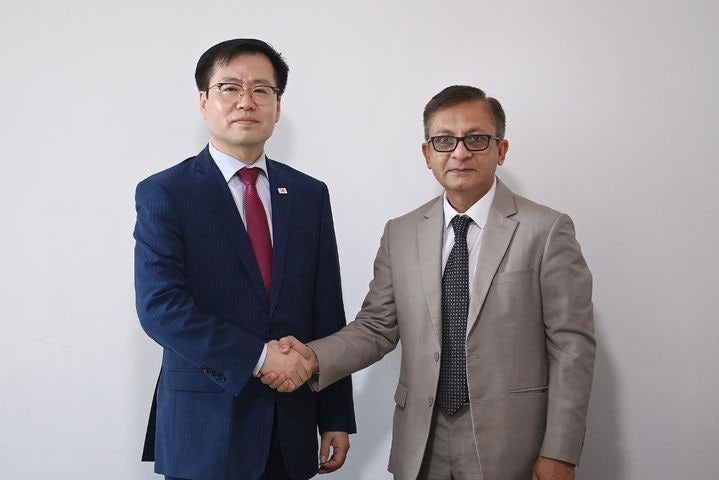
South Korea and Bangladesh reached a preliminary agreement Tuesday on a comprehensive economic partnership agreement that would cut tariffs on Korean food, vehicles and industrial goods while widening access to each country’s services and infrastructure markets.
Trade Minister Yeo Han-koo and Bangladeshi Commerce Minister Khandaker Abdul Muktadir announced the conclusion of negotiations in Dhaka. The deal is Korea’s second CEPA with a South Asian country after India.
Seoul said the accord would give Korean companies greater access to Bangladesh, a fast-growing market of about 170 million people.
“The Korea-Bangladesh CEPA will connect Korean companies with a promising market of 170 million people,” Yeo said, adding that it would broaden bilateral ties beyond merchandise trade.
Bangladesh will eliminate tariffs on Korean instant noodles, coffee preparations, seasoned seaweed and snacks, which currently face duties of up to 85.6 percent.
It will also scrap a 6 percent tariff on diesel, Korea’s largest export to Bangladesh, and remove duties on key semi-knocked-down vehicles and all auto parts. Korean finished vehicles will receive treatment no less favorable than those from other trading partners, the ministry said.
Tariffs will also be lifted on lubricant base oils and washing machines, while flexible rules of origin will apply to major exports including petrochemicals, steel, electrical equipment, machinery, food and cosmetics.
The agreement will open more than 90 service sectors to Korean companies, including content, e-learning, health care, telecommunications, construction and distribution.
Tariffs of up to 10 percent on Korean hot- and cold-rolled steel will be phased out, while duties on construction equipment and agricultural and textile machinery will be removed immediately. Seoul said the provisions would improve opportunities for Korean companies in Bangladesh’s road, railway, port and power projects.
In return, Korea will grant duty-free access to all Bangladeshi clothing and footwear, as well as leather goods, jute, spices, black tea and baked goods. Leaf tobacco was excluded to protect Korean farmers.
The CEPA also covers cooperation in infrastructure, manufacturing, textiles, halal industries, digital transformation, energy, supply chains and the clean economy.
The two countries launched negotiations in November 2024 and held five formal rounds of talks. They will now finalize technical details before signing the agreement and completing domestic procedures for it to take effect.