
 KB News Desk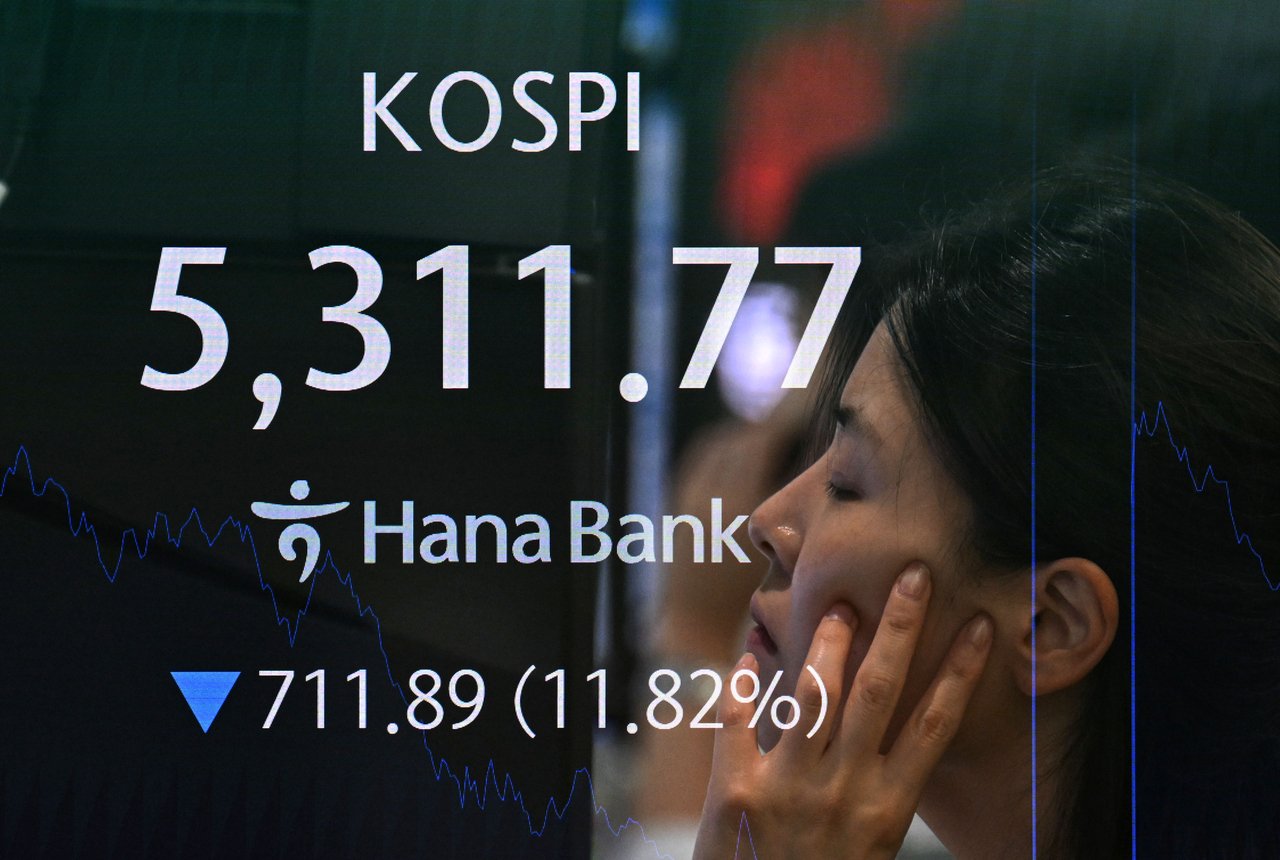
16 funds launched at market’s peak, amplifying moves in Samsung Electronics, SK hynix and Kospi
Earlier this year, South Korea emerged as the world’s best-performing stock market as an artificial intelligence-driven memory chip boom propelled the country’s top chipmakers Samsung Electronics and SK hynix to record highs.
The chip rally, however, quickly unraveled as investors grew concerned that Big Tech companies would scale back AI infrastructure spending. The two chip giants have since fallen more than 30 percent from their peaks, dragging down the benchmark Kospi.
Yet what stood out was not just the depth of the sell-off, but the extreme volatility that followed. The Kospi seesawed almost daily as investors alternated between bargain hunting after steep declines and panic selling amid renewed concerns.
Amid the turmoil, attention has turned to a new breed of financial products: single-stock leveraged exchange-traded funds.
Unlike conventional ETFs that boast greater stability by tracking a basket of stocks, single-stock leveraged ETFs are linked to the performance of just one company — in this case Samsung Electronics or SK hynix. The products seek to deliver twice the stock’s daily return, magnifying both gains and losses.
Originally introduced to deepen Korea’s capital markets, the ETFs have instead come under fire for exacerbating volatility in the country’s market heavyweights, the broader Kospi and even global semiconductor shares.
What fueled the frenzy
From their debut in May, the single-stock leveraged ETFs were a big hit. Investors poured into the funds in anticipation that the chip rally had further to run.
On their debut day, the products recorded more than 10 trillion won ($6.9 billion) in trading value, accounting for nearly one-third of all ETF trading. Since then, daily trading has consistently hovered around that level.
Combined assets under management peaked at 17.6 trillion won at the end of last month before falling to 9.92 trillion won as the chip rally reversed.
The surge underscored the speculative appetite among retail investors eager to amplify gains from the country’s two biggest chipmakers.
“This exposes some longer-term challenges of the Korean market, such as a comparatively weak institutional investor base and a retail base with a strong speculative appetite and concentrated index composition,” said Yan Wang, chief emerging markets strategist at Alpine Macro, an independent investment research firm in Montreal.
Looking back, market experts say the problem was not the products themselves, but the sheer number launched simultaneously. All 16 funds debuted at once, just as the chip rally was peaking, exacerbating market volatility as the AI-driven boom began to unwind.
“In hindsight, the problem was that too many products were launched all at once. The timing could not have been worse, too,” an official at a foreign asset manager said.
What drove the volatility
Single-stock leveraged ETFs are designed to deliver twice the daily return of Samsung Electronics or SK hynix. To maintain that double exposure, fund managers must rebalance their holdings at the end of every trading day.
If Samsung Electronics rises during the session, the ETF needs to buy more shares before the market closes to restore its targeted leverage. If the stock falls, the fund must instead sell shares. The daily rebalancing can reinforce existing market momentum, fueling further gains on up days and steeper losses on down days.
Given Samsung Electronics and SK hynix together account for more than half of the Kospi by market capitalization, the resulting price swings can also spill over into the broader index, adding to overall market volatility.
Market experts, however, stress that the funds are not the primary cause of volatility, but rather an amplifier of existing market moves.
“The leveraged chip ETFs do not create volatility from scratch. They simply magnify it,” said Lee Hyo-seob, a senior research fellow at the Korea Capital Market Institute.
“The surge in leveraged ETFs in Korea has indeed amplified market volatility,” Wang agreed.
“However, it is noteworthy that SK hynix and Micron’s stock prices have moved almost identically since late last year, suggesting that the global semiconductor/AI-memory cycle has been a far more important driver of the Korean market than leveraged positioning.”
What’s to be done
Local regulators have responded by tightening restrictions on single-stock leveraged ETFs. The new rules raise the minimum deposit requirement and increase the minimum trading unit with the aim of curbing trading.
Still, the measures are unlikely to eliminate the source of the volatility altogether. As long as existing leveraged ETFs continue to rebalance their positions every day, large price swings in Samsung Electronics and SK hynix can still trigger sizable end-of-day buying or selling.
“Volatility is unlikely to disappear anytime soon,” Lee said.
Beyond the regulatory measures, however, signs are emerging that the market may be cooling on its own as the extreme volatility subsides.
“Unlike the resilience in investor inflows observed during the earlier crisis, we are now starting to see softness in leveraged ETF inflows, particularly in products linked to Samsung Electronics,” said Rajat Agarwal, who spearheads Asia equity strategy at Societe General.
“The current prices of these leveraged ETFs are more than 50 percent below their volume-weighted average purchase price since launch, suggesting that investor conviction may be weakening as losses deepen.”