

 KB News Desk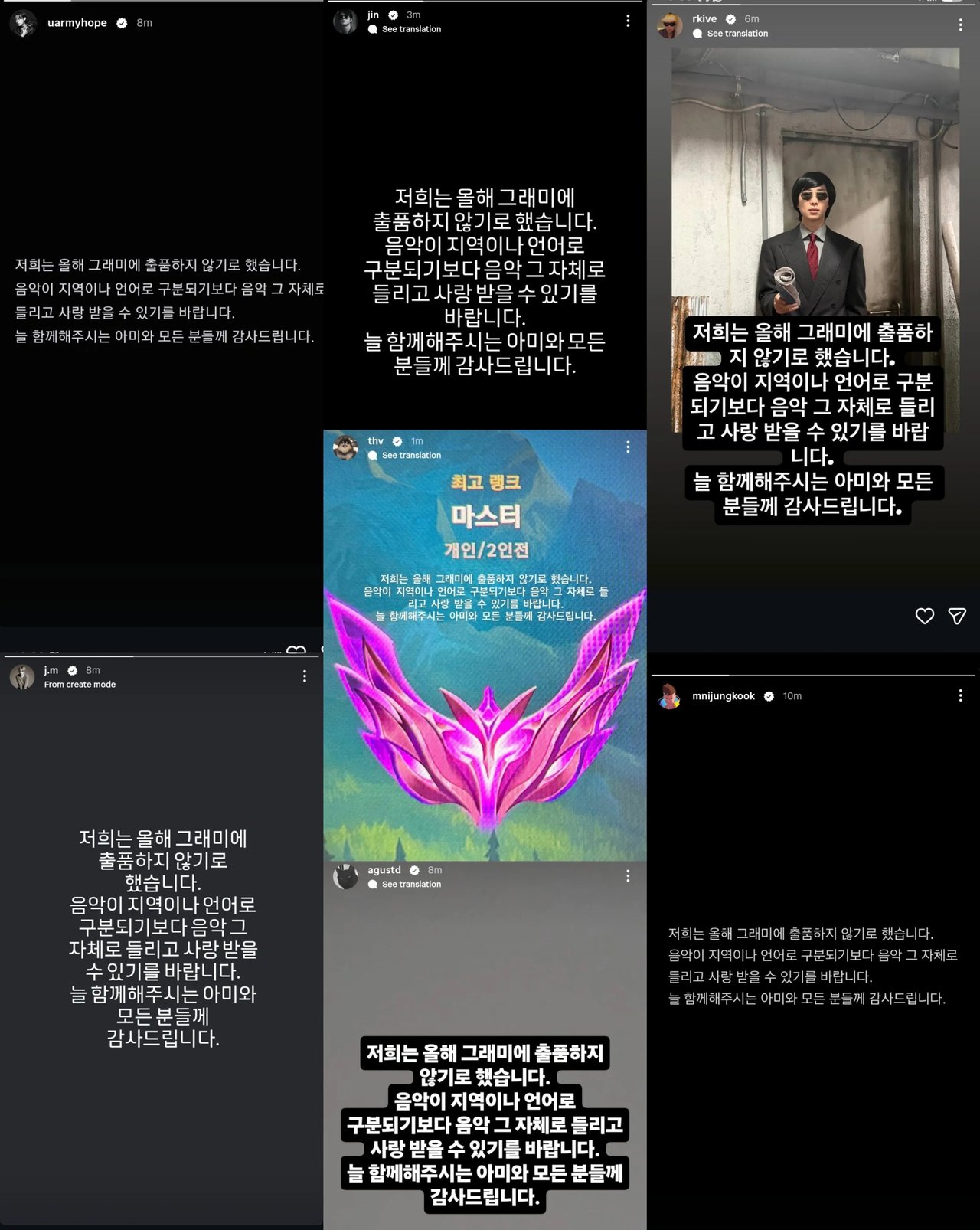
Seoul scholar reads boycott as authority withdrawn. Category’s own architects say it was never meant for the supergroup
BTS’ announcement that it will not submit music to next year’s Grammy Awards has set off a wave of reactions.
The group’s fandom answered on the charts. Army, as the group’s fans are known, pushed “Aliens,” a B-side from the group’s fifth full-length album “Arirang” about being cast as outsiders and owning the label, to No. 1 on iTunes song charts in 78 regions this week, months after the album’s release.
Many see that the group’s decision as a protest against the Recording Academy’s new best Asian pop music performance category, which critics and fans have described as a way of walling BTS and other Asian acts off in a subcategory.
Under Academy rules, a song may be entered in only one performance category each year, so a submission to the Asian pop award would cost the group a place in best pop duo/group performance, the broader category where it was nominated three times from 2021 to 2023 without winning. The seven bandmates each posted online that they hope “music can be heard and embraced for what it is, beyond region or language.”
An award is not just a trophy. It is authority — and authority holds only as long as people agree to grant it. On Wednesday, one of the biggest acts in global music stopped agreeing. That is how Hong Seok-kyeong, a communications professor at Seoul National University who researches Hallyu, read the boycott in an interview with The Korea Herald on Friday.
Awards confer authority and authority produces a hegemonic effect, she said, but that effect does not run on force. It runs on consent that is given voluntarily, and it fails when the consent is withdrawn. In Hong’s reading, BTS did exactly that.
Hong went further, arguing that K-pop no longer needs the authority of the American music establishment at all. Its rise, she said, was built upward from fandom rather than granted from above by Western critics and gatekeepers, which is why an industry accustomed to conferring status has struggled to accept it.
Not everyone involved in creating the category accepts that reading.
Zeena Koda, a Recording Academy member who said she sat on the committee that pushed for the new award, said in a series of Instagram posts that it was never designed with BTS in mind. “This is a new category and nothing is perfect and its first iteration — in many ways this wasn’t a category for BTS at all,” she wrote. “This was for artists that need more visibility and shine — NOT decades deep pop superstars.”
Koda, co-founder of the Asian American Collective and a marketing executive at Universal Music Enterprises, said the award followed years of work by people building Asian visibility at the Grammys where none had existed before, and that winners are decided not by the public, but by “a vetted group of music professionals+ artists in a membership community that genuinely, deeply cares about representation.” The category “was not meant to be a final solve, but a step forward in the right direction,” she wrote.
“Instead, we’ve been torn down by one of the biggest Asian artists.”

The Recording Academy echoed Koda’s framing, with its CEO issuing a statement clarifying that entering a genre category “does not exclude an artist from also submitting and being considered in the General Field categories, including Record of the Year, Album of the Year and Song of the Year.”
Category issues aside, the Grammys have faced a deeper structural reckoning over how they decide what counts as excellence. What makes this gatekeeping so difficult for the Academy to defend is that Grammy authority relies on subjective peer voting rather than transparent metrics. Nominees are chosen by roughly 15,000 voting members — singers, producers and engineers — without chart position or streaming figures factored into eligibility.
Even after abolishing its controversial secret nomination review committees in 2021, the Academy remains under scrutiny for who its system elevates. High-profile boycotts and critiques from artists like The Weeknd, Frank Ocean and Jay-Z have repeatedly highlighted a voting body that, by the Academy’s own disclosures, remains predominantly male and over 40 — leaving it out of step with global, youth-driven pop movements.
While that system was drawing fresh scrutiny, a different kind of awards show was being announced in Seoul. On July 27, two days before the BTS posts, JYP Entertainment founder J.Y. Park unveiled Fanomenon, a government-backed K-culture festival and awards program built with the cooperation of Hybe, SM Entertainment and YG Entertainment.
Park’s central promise was that the new awards would not be decided by voting.
“This will not be a vote. It will run on data researched in obsessive detail,” he told reporters, outlining a model where organizers track global fan activity across platforms like Spotify and YouTube through independent data firms.
By anchoring legitimacy in measurable audience engagement rather than closed-door peer consensus, Fanomenon attempts to offer an alternative source of authority entirely.
Yet replacing institutional judgment with raw data brings its own complications. As professor Hong points out, quantifying fandom activity risks turning audience passion into a competitive metric, pitting fan bases against each other rather than celebrating collective culture.
Ultimately, both models are chasing the same elusive goal: a system of recognition that audiences and artists alike view as unassailable. The Grammys rely on nearly seven decades of institutional legacy and peer review, while the emerging K-pop awards places its bet on the hard, quantifiable metrics of the crowd.
Neither approach is without flaws. Yet for an institution like the Recording Academy, maintaining authority across its next era will require more than defending a static rule book.
A system built on nearly 70 years of tradition cannot remain indifferent to seismic shifts in technology, global fan dynamics and how music is consumed across borders. As BTS’ exit proves, authority is not guaranteed by longevity — it relies on continuous, voluntary consent. And once that consent begins to erode, no legacy is too historic to escape the crack in the foundation.