
 KB News Desk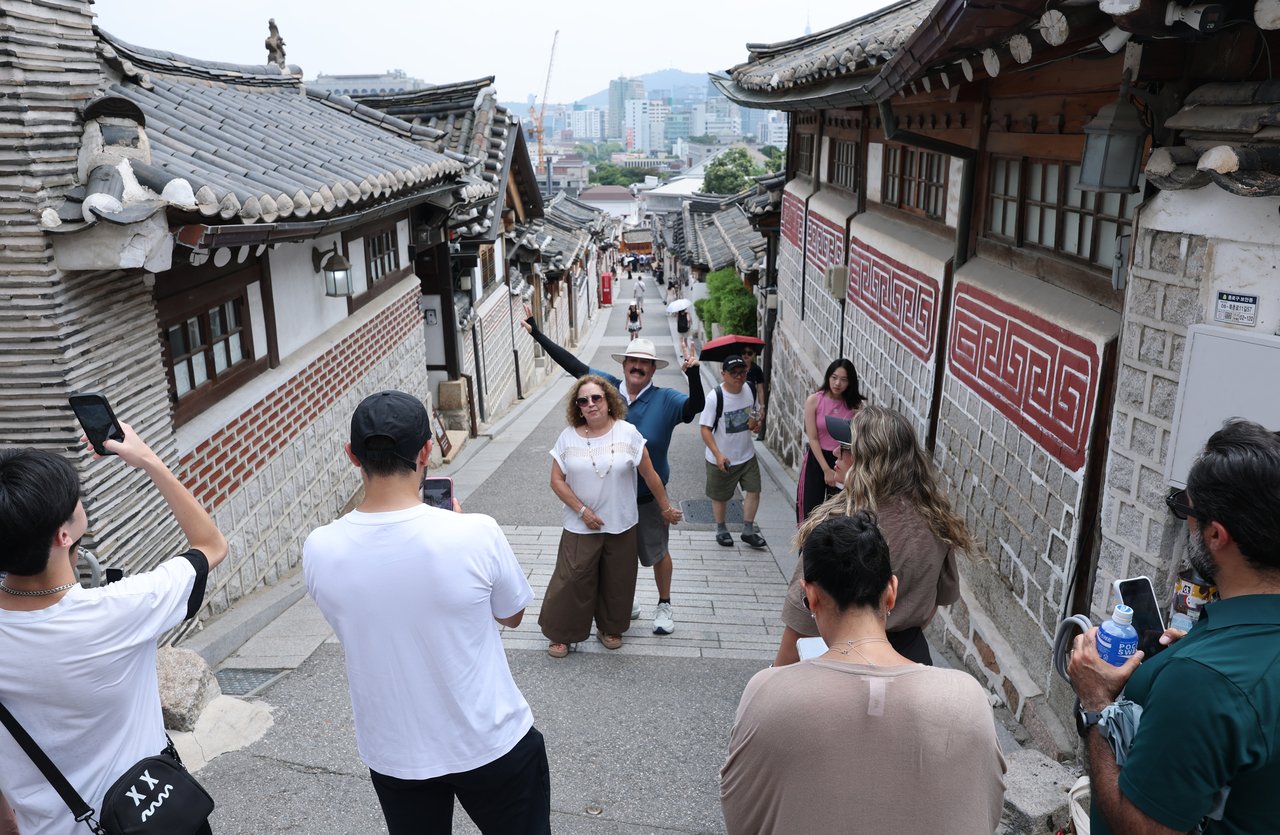
Chinese tourist spending jumps 82.7% as health care leads sector growth
Spending by foreign tourists in South Korea surged in the first half, driven largely by a rebound in Chinese visitors and rapid growth in medical tourism, BC Card said Monday.
The credit card company analyzed transactions made with 3.3 million foreign-issued cards and found that total spending rose 53.6 percent from a year earlier while the number of transactions increased 40.3 percent.
BC Card did not disclose the total amount spent. A separate report released last week by the Ministry of Culture, Sports and Tourism estimated that foreign visitors spent 10.04 trillion won ($7 billion) in the first half, up 50.8 percent from the same period in 2025.
The number of cards used by Chinese visitors rose 56.6 percent on-year, followed by those from Singapore at 46.8 percent, Taiwan at 44.3 percent and Japan at 40.1 percent.
Spending by Chinese visitors grew even faster, jumping 82.7 percent over the same period.
“The recovery in the number of Chinese visitors, Korea’s largest inbound tourism market, drove the overall rise in consumption,” BC Card said.
The data also suggested that foreign-tourist spending was spreading beyond traditional destinations.
Spending in Seoul remained strong, with increases also recorded in districts outside major tourist areas such as Myeong-dong. Payments in Busan and on Jeju Island rose 57.9 percent and 63.7 percent, respectively.
Medical tourism fuels growth
Foreign visitors’ card spending on medical services nearly doubled in the first half, rising 98 percent from a year earlier. That was the fastest growth among major sectors, ahead of clothing, where spending increased 56.3 percent.
Medical spending rose across major regions, but Seoul still accounted for 92.8 percent of the total.
Gangnam-gu, Seoul, home to a dense concentration of cosmetic surgery and dermatology clinics, accounted for 39.8 percent of medical spending by foreign visitors in the capital.
Although Gangnam remained the largest destination, its share fell 10.4 percentage points from the first half of last year.
Seocho-gu’s share rose 6.7 percentage points to 27.6 percent, while Jung-gu’s increased 3.4 percentage points to 7.5 percent.
Dermatology accounted for 67.5 percent of foreign visitors’ medical spending, well above plastic surgery at 21.3 percent.
That marked a reversal from the first half of 2024, when plastic surgery made up 46.2 percent of medical spending and dermatology accounted for 32.6 percent.
Spending on dermatology rose 109.8 percent from the first half of 2025, while spending on plastic surgery increased 35.5 percent.
Pharmacy spending also recorded a sharp increase, soaring 1,176.9 percent on-year. Its share of foreign visitors’ medical spending rose from 0.3 percent in the first half of 2025 to 2 percent this year.
“A new tourism ecosystem linking medical services and shopping appears to be taking shape,” BC Card said. “Medical tourism is expected to emerge as a new growth engine for inbound tourism.”