
 KB News Desk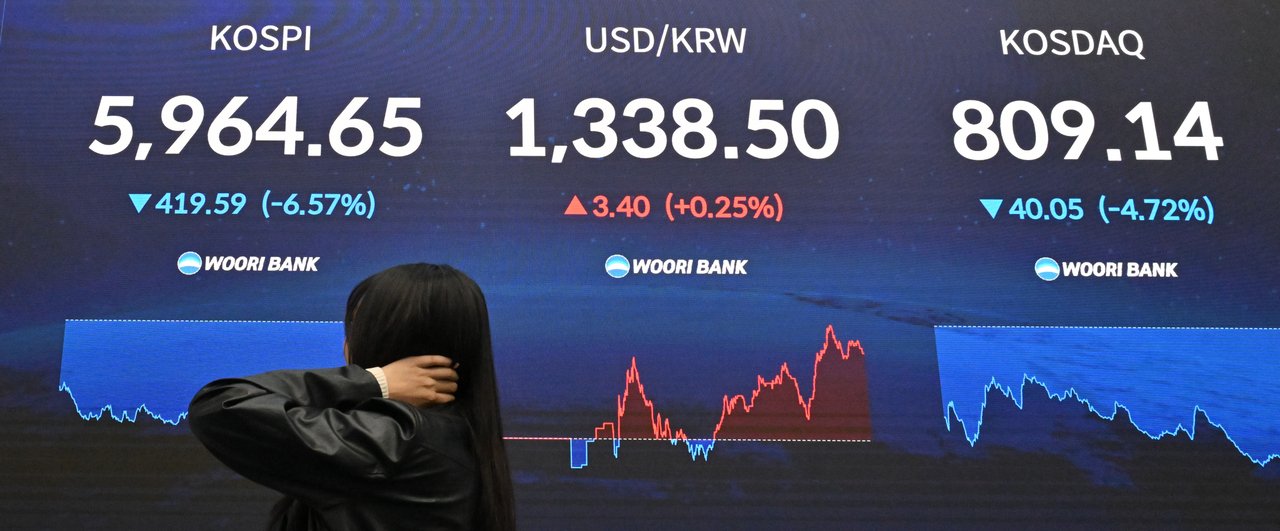
Benchmark briefly slips below 6,000 as Samsung, SK hynix plunge; analysts warn sustained overseas outflows pose deeper risk
Foreign investors’ relentless selling sent South Korea’s Kospi plunging more than 5 percent Tuesday, briefly pushing the benchmark below 6,000 as sustained capital outflows overshadowed strong semiconductor earnings and raised concerns over the market’s outlook.
The Kospi closed at 6,035.35, down 5.46 percent, after slipping below 6,000 intraday before recovering some losses in the afternoon. The plunge triggered a sell-side sidecar for the first time in nearly two months, temporarily suspending program-trading sell orders.
Semiconductor heavyweights led the decline, with Samsung Electronics falling 7.39 percent and SK hynix tumbling 10.09 percent.
The selloff followed overnight weakness in US technology stocks. Nvidia fell 1.3 percent, Micron Technology lost 3.9 percent and the Philadelphia Semiconductor Index dropped 2.67 percent.
Concerns over Chinese memory chipmaker ChangXin Memory Technologies, or CXMT, added to the pressure. The company reportedly plans to introduce server DDR5 memory chips using a more compact cell design by year-end, potentially improving production efficiency and cost competitiveness.
The Kospi has shed more than 1,000 points over the past five trading sessions, retreating from above 7,000. The rout has wiped out more than 800 trillion won ($595.5 billion) in market capitalization, pushing the total below 5,000 trillion won.
Foreign investors sold a net 2.2 trillion won worth of Kospi shares Tuesday, bringing their net selling this month to nearly 8 trillion won. Their net selling has reached 199 trillion won this year, including about 177 trillion won in the first half. Outflows eased in July and August before accelerating again in September, when they totaled 21.5 trillion won.
The sustained withdrawals have raised questions about whether foreign investors are merely taking profits after the market’s earlier rally or reassessing their exposure to Korean equities.
Analysts said persistent foreign selling posed a greater threat to the market than the latest developments in the semiconductor industry.
Heo Jae-hwan, an analyst at Eugene Investment & Securities, said foreign selling pressure in Korea was more than three times as intense as in Taiwan relative to market size.
Taiwan’s stock market has gained more than 70 percent this year, compared with the Kospi’s 51 percent rise as of Monday’s close.
“The outflows are too large to be attributed solely to portfolio rebalancing after the rally,” Heo said, adding that domestic investors would need to absorb the selling pressure.
That could prove difficult. Retail investors remain cautious following July’s market decline, while institutional investors, including the National Pension Service, have limited room to increase their stock holdings.
Lee Jae-won, an analyst at Yuanta Securities, said foreign fund flows had become a greater concern than semiconductor earnings.
“Samsung Electronics’ third-quarter operating profit exceeded market expectations, and memory prices and investment in AI infrastructure remain firm. However, persistent foreign selling is weighing on the Kospi’s performance relative to other markets,” Lee said.
Higher interest rates, rising oil prices and geopolitical uncertainty have intensified the pressure, though analysts said these factors alone could not explain the sustained foreign withdrawals.
Korea’s heavy dependence on memory chipmakers has also made its market particularly vulnerable to shifts in semiconductor sentiment. US and Taiwanese equities, by contrast, benefit from broader exposure to AI services, infrastructure and advanced chip manufacturing.
Han Ji-young, an analyst at Kiwoom Securities, said concerns over CXMT and weakness in US semiconductor stocks were amplifying volatility. She identified the Kospi’s 200-day moving average as a key technical support level.
“Given that the Kospi has fallen nearly nine percent over the past four trading sessions and its forward price-to-earnings ratio has dropped below five, a short-term technical rebound is possible,” Han said.