
 KB News Desk
South Korea’s Army pledged Thursday to strengthen safety controls and medical support for reservists during training, after concluding that a reservist who died during a mobilization exercise in May had died from a preexisting medical condition.
The announcement came amid growing public criticism of the military’s handling of the case. A public petition calling for the impeachment of Defense Minister Ahn Gyu-back, uploaded on June 18, had gained more than 260,000 signatures as of Thursday. The petition also accused the ministry of mishandling the reservist’s death.
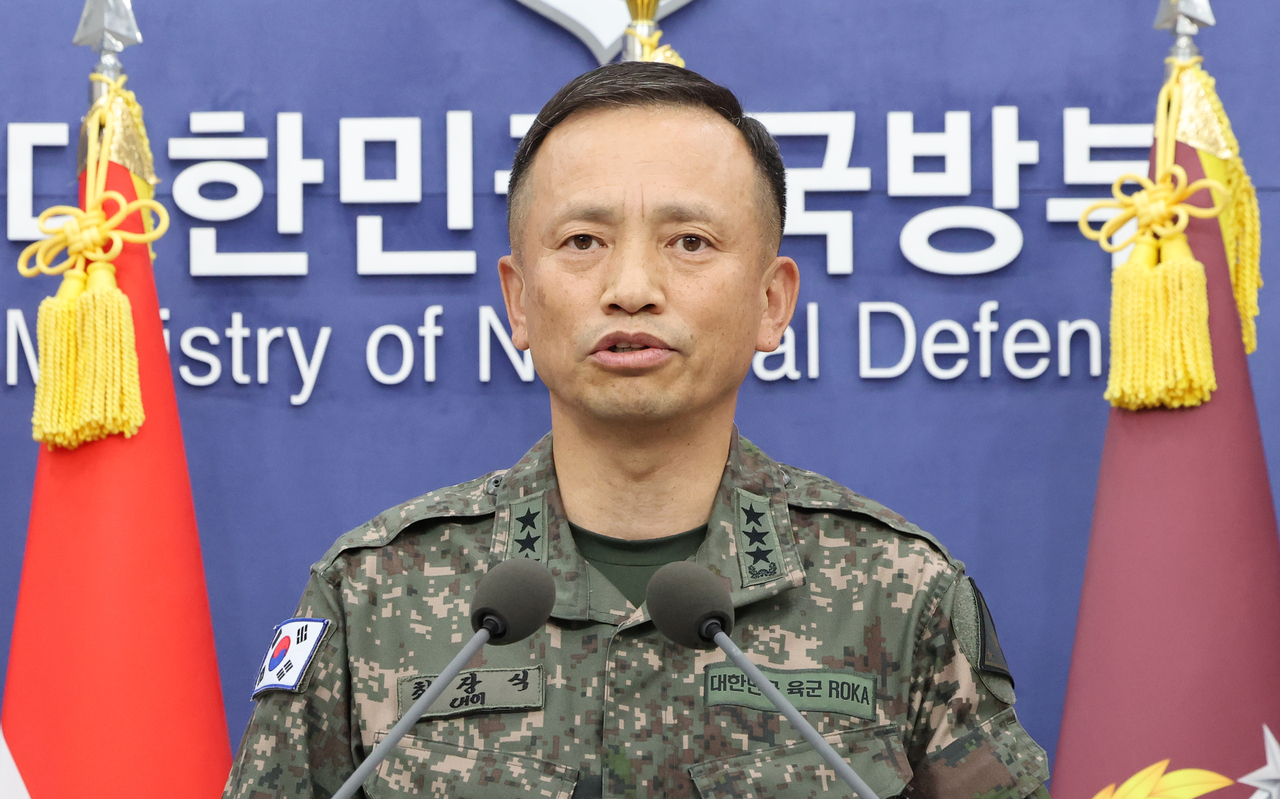
Army Vice Chief of Staff Lt. Gen. Choi Jang-sik announced the findings at a briefing at the Defense Ministry headquarters in Yongsan-gu, Seoul.
According to the Army, the reservist took part in the Ssangyong mobilization exercise, held from May 12 to 14 in northern Gyeonggi Province, as a member of the 73rd Infantry Division. The exercise involved active-duty troops and reservists forming a mobilized division and conducting field training at locations where they would be deployed in an actual contingency.
The Ssangyong exercise is known to be one of the more intensive mobilization drills for reservists. But the Army said it reached its conclusion based on the autopsy and civilian forensic reviews.
According to the Army, the reservist collapsed at around 7 p.m. on May 13, the second day of training, while moving to a night training site after dinner. Military personnel at the scene administered emergency aid before he was transported by an 119 ambulance to a nearby civilian hospital. He died later that night.
Choi said an autopsy conducted in the presence of the bereaved family found that the cause of death was pancreatitis, for which the reservist had been receiving treatment before entering training.
“The Army also requested opinions from two civilian forensic advisory institutions, and both confirmed that the disease had a causal relationship to the death,” Choi said.
The Army dismissed recent allegations that a division commander used drones to monitor reservists during the training.
It said the drones were used not for surveillance but as part of training scenarios and to demonstrate the Army’s broader plan to expand drone use. The division commander was inspecting another training site at the time, the Army said.
Still, the Army acknowledged that the investigation had identified shortcomings in medical support and safety control systems for reserve training, and pledged follow-up measures.
The Army said it would require dedicated medical evacuation teams to be stationed at all reserve training sites to ensure prompt emergency treatment. It plans to finalize the system this year.
It also plans to reinforce emergency medical personnel and expand the deployment of automated external defibrillators from battalion-level units to company-level units.
The Army will also improve health questionnaires for reservists. The current forms consist mainly of simple questions on chronic and infectious diseases, but they will be revised to more closely assess past illnesses, specific symptoms and recent health conditions.
The Army said it would improve training conditions and facilities, including showers, restrooms and temporary dining facilities.
“The Army recognizes the lives and safety of participating reservists as a top priority, no less important than the outcome of training,” Choi said. “Taking this incident as a lesson, we will review and improve the reserve training system.”
Choi added the Army would “restore public trust through fact-based explanations and transparent disclosure of information, and humbly improve the problems that have been identified.”