
 KB News Desk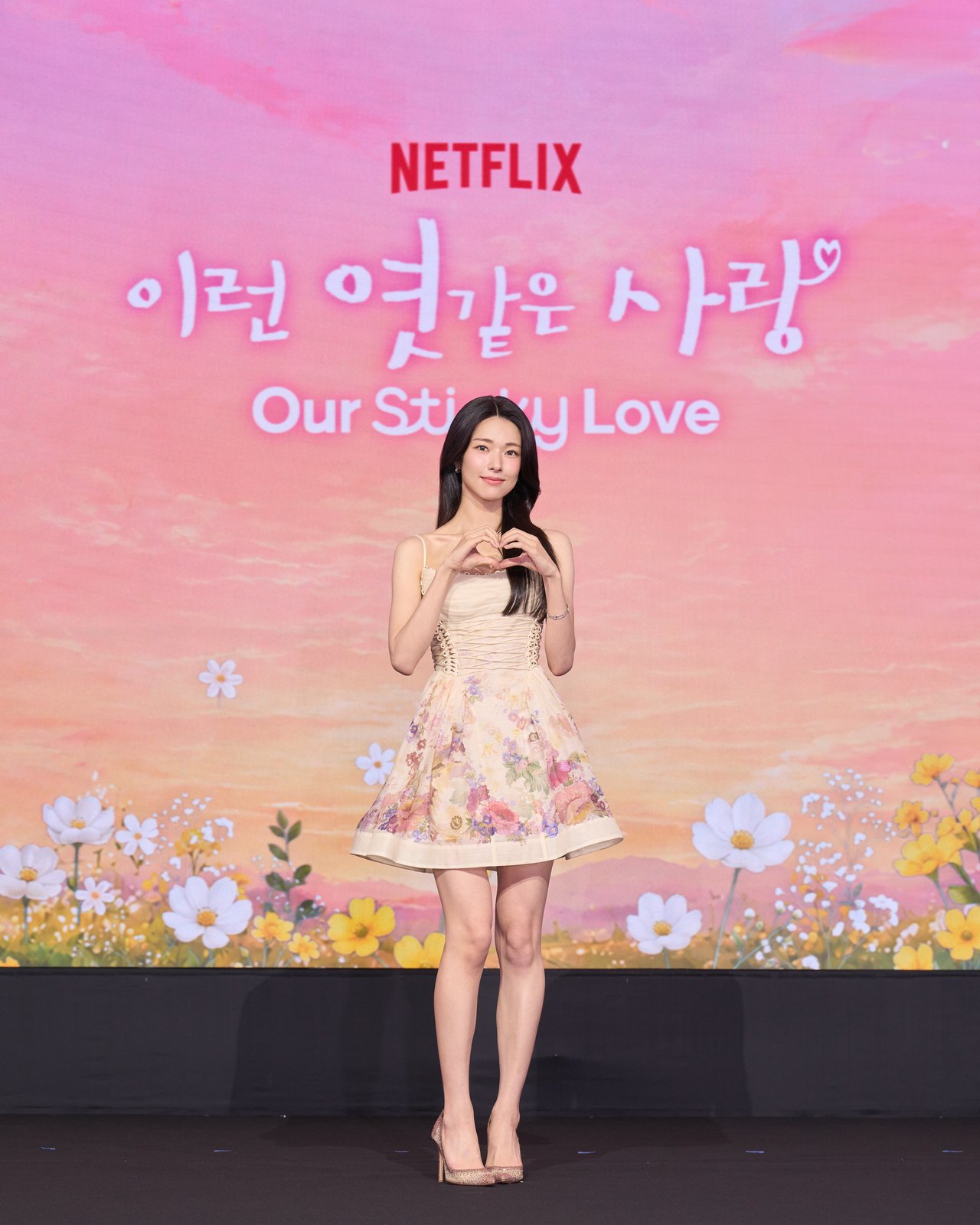
The controversy reveals how sensitive Korea remains about its colonial past — and why public figures should know better, experts say
Ahn Ha-young’s rising career has hit a major roadblock after comments about her family history sparked backlash over allegations that her great-grandfather was linked to Japan’s colonial rule of Korea, just days before Liberation Day on Aug. 15.
The uproar has revived the debate over whether descendants should be held accountable for their ancestors’ actions — with experts stating the Korean public increasingly places more weight on how descendants conduct themselves today than on their lineage alone.
The issue at hand emerged during Ahn’s promotional campaign for “Our Sticky Love,” Netflix Korea’s highly anticipated romantic comedy, which premiered globally last week.
Ahn, who made her acting debut in 2019, has spent much of her career in supporting roles, appearing in projects including the hit series “The Trauma Code: Heroes on Call” and “Doona!” “Our Sticky Love” marks one of her first major leading projects.
At a time when Ahn was gaining prominence, her mentions of her family background on several television programs resurfaced, with one of the most recent examples being her Aug. 7 appearance on KBS’ variety show “Problem Child in House.” During the show, Ahn said her great-grandfather had opened a Western-style clinic in Hanyang (Seoul’s former name) and treated Emperor Gojong. She added that her grandfather, father and older sister are doctors, making hers a four-generation family of doctors.
Although Ahn did not identify her great-grandfather by name during the broadcast, online speculation soon pointed to Ahn Sang-ho, a doctor who practiced during Japan’s colonial rule of Korea.
The great-grandfather
Attention quickly turned to Ahn Sang-ho’s activities during the colonial period, particularly his involvement with the Daejeong Friendship Association. Founded in 1916 as a business organization, the group was led by Min Yeong-gi, a known pro-Japanese collaborator, and included several figures associated with Japan’s colonial government. Among them was Yi Wan-yong, one of the signatories of both the 1905 Eulsa Treaty and the 1910 Japan-Korea Annexation Treaty, which formally placed Korea under Japanese rule.
The allegations triggered immediate backlash against Ahn.
Her agency, Bistus Entertainment, initially dismissed claims that Ahn Sang-ho was a pro-Japanese collaborator on Monday but reversed course the following day. Further verification had confirmed historical records identifying Ahn Sang-ho, the actor’s great-grandfather, as a council member of the Daejeong Friendship Association. The agency apologized for issuing its initial statement before sufficiently verifying the information.
Press interviews with Ahn and her co-star, Jung Hae-in, were subsequently canceled, dealing a setback to the drama’s global promotional campaign as well as her multi-million dollar commercial ad opportunities. As the controversy intensified, Ahn issued a public apology Wednesday, saying she had been unaware of her ancestor’s past.
According to experts, the intensity of the backlash may hinge not simply on the existence of the historical record, but on how Ahn’s great-grandfather’s role during the colonial period is interpreted.
“There were different degrees of collaboration with Japan during the colonial period,” said Lee Sung-min, an associate professor in the Department of Media Arts and Sciences at Korea National Open University.
While some figures may technically be categorized as pro-Japanese despite having had limited choices under colonial rule, Lee said others actively cooperated with the colonial authorities.
“Ahn’s great-grandfather appears to fall closer to the latter category,” Lee said.
Historic sensitivity
But experts add the more fundamental issue may not be Ahn’s ancestry itself, but how she presented her family history.
“People would be more uncomfortable not with the fact itself, but with how the descendants conduct themselves,” said pop culture critic Jung Duk-hyun, pointing to cases in which descendants distort the past or speak about their ancestors’ actions with pride.
“Even if someone is a descendant, if they have a negative view of their ancestor’s actions, they’re unlikely to go around highlighting or taking pride in that connection. They can instead take a more humble stance or show greater interest in and engagement with those historical issues. I don’t think the (Korean) public would necessarily criticize them if they responded in those kinds of ways,” Jung said.
The controversy arrives at a particularly notable moment in Korea-Japan relations, as cultural exchange between the two countries has entered a high point in relations.
According to Hankook Research, Japan’s favorability rating among South Koreans stood at 44.8 degrees in a July 2026 survey, up from 42.7 degrees in April and 44.6 degrees in January. It was the highest rating recorded since the firm began measuring favorability toward the countries surrounding Korea — China, Japan, North Korea, Russia and the US — in 2018. The survey uses what it calls a “feeling thermometer” ranging from 0 degrees, meaning very unfavorable, to 100 degrees, meaning very favorable.
However, experts stress that Koreans maintain a boundary between contemporary lifestyle trends and historical accountability.
“Cultural exchange and consuming each other’s cultural content is essentially a matter of personal taste,” Jung said, noting that audiences separate entertainment choices from unresolved colonial grievances.

That growing separation between Japanese culture and the country’s colonial past, however, does not necessarily apply to the descendants of those who collaborated with Japan.
“Obviously, (descendants of pro-Japanese collaborators) are not going to be viewed favorably. But I do think some of these tensions are gradually being resolved,” Lee said, adding that since anti-Japanese sentiment has been passed down across generations, there is also a growing degree of nuance and rationality in how some Koreans approach the issue.
“If someone can clearly distinguish between the two by saying, ‘What my parent did was wrong, but I am a different person,’ then people can see that person as someone who shares the same basic values,” Lee said.
“But in this case, that distinction wasn’t really made. There seemed to be a lack of awareness of what was wrong in the first place.”