
 KB News Desk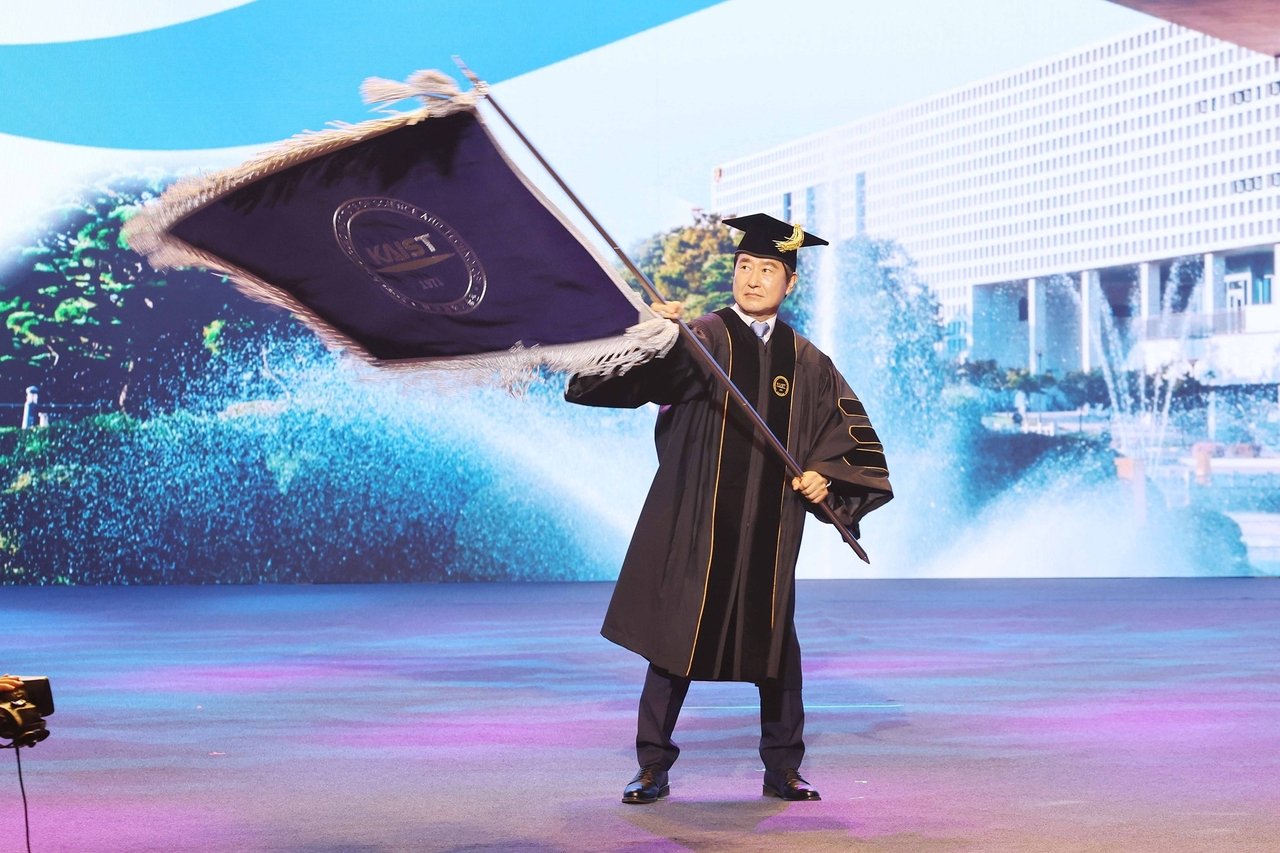
Bae Choong-sik eyes more international students, overseas scholars and joint research in broader global push
DAEJEON — Bae Choong-sik was inaugurated Monday as the 18th president of the Korea Advanced Institute of Science and Technology. With him come plans to remodel the university for the AI era.
Rather than treating artificial intelligence as a specialized field, Bae said KAIST would seek to make it a common language and general-purpose tool across disciplines. From AI-powered classrooms and autonomous laboratories to research in robotics and other forms of physical AI, the vision seeks to change how students learn, researchers work and the university itself operates.
“I will move forward under the goal of ‘Fundamentals First, Innovation Forward,’ while carrying on KAIST’s core values of creativity, challenge and caring and its vision of becoming a global leader in value creation,” Bae said at his inauguration ceremony on the university’s main campus in Daejeon.
The approach reflects what Bae described as “Continuity and Innovation.” While strengthening education in basic sciences, mathematics and the humanities, KAIST plans to equip students across disciplines to use AI as part of their everyday academic work.
One of the more ambitious pieces of the plan is an “AI Native Campus,” which seeks to integrate AI-based interactive learning, autonomous research laboratories and AI-assisted administrative systems. Bae said the aim is for KAIST to move beyond being a university that uses AI effectively and become one that leads innovation in the technology itself.
The university also plans to expand research in physical AI, where artificial intelligence interacts with the physical world through technologies such as robotics, autonomous driving and advanced manufacturing.
KAIST will pursue research in humanistic, democratic and agentic AI, as well as in strategic areas such as quantum technology, climate and energy.
The emphasis on AI is part of five broader development strategies Bae presented for his presidency, covering education and research, deep-tech entrepreneurship, institutional reform, sustainability and internationalization.
On entrepreneurship, KAIST plans to attract more corporate satellite laboratories and collaborative research centers and deepen cooperation with industry in research and technology commercialization. It will also introduce new entrepreneurship programs for incoming students.
Bae pledged to reduce unnecessary regulations and administrative procedures, saying AI-based digital administration could allow faculty and students to devote more time to research and education.
The university also plans to use its campus as a testing ground for climate and energy technologies as part of efforts to move toward carbon neutrality.
Another focus will be expanding KAIST’s international reach through dual-degree programs, overseas research partnerships and recruitment of international students and faculty.
“We will dramatically increase the number of international students by attracting more outstanding students through dual-degree programs, involve distinguished overseas scholars in dissertation evaluations, establish a global advisory group and encourage international joint research,” Bae said.
Bae, who took office July 1 and was formally inaugurated Monday, specializes in environmentally friendly energy and carbon-neutral power engineering. He earned his bachelor’s degree in aeronautical engineering from Seoul National University and a doctorate in mechanical engineering from Imperial College London.
Since joining KAIST in 1998, he has served as head of the Department of Mechanical Engineering and dean of the College of Engineering, among other posts.