
 KB News Desk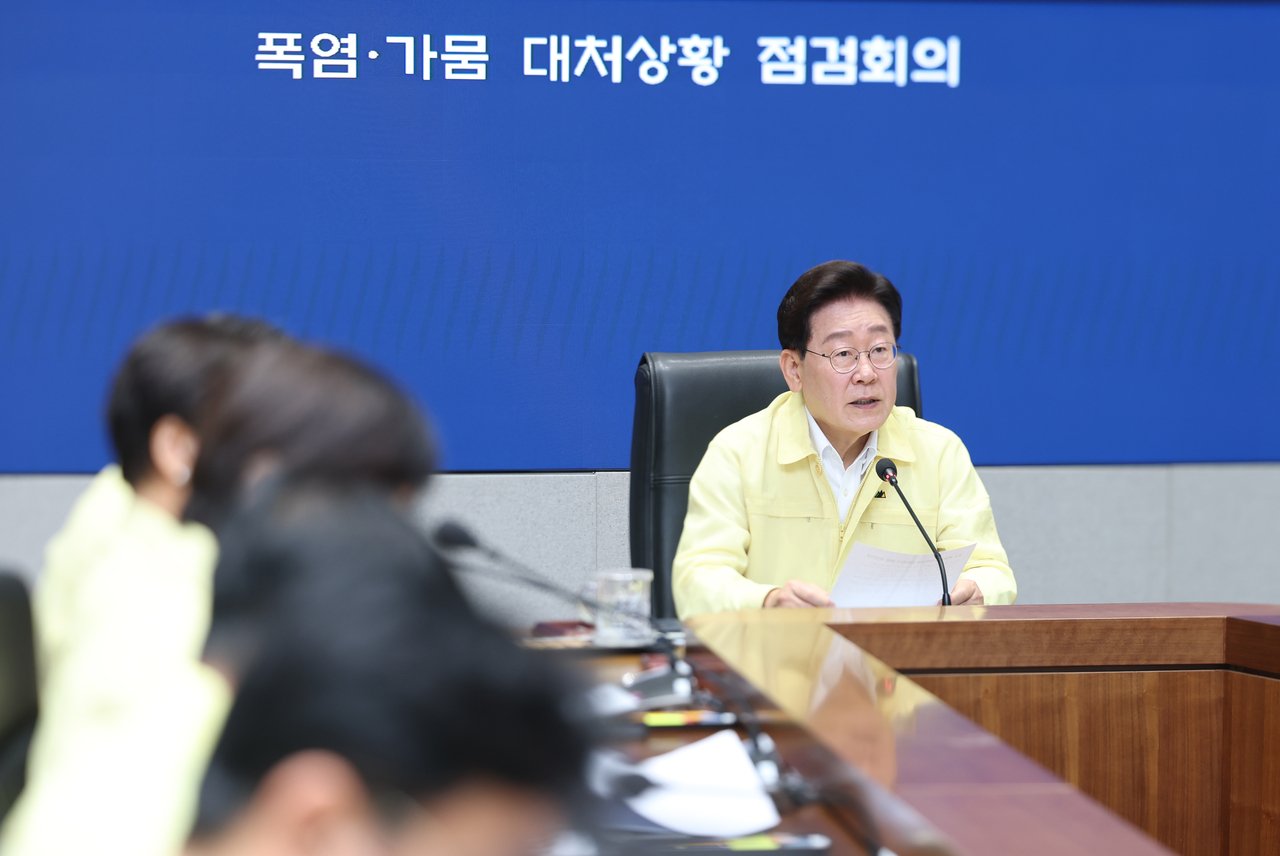
* 추가 자료 나오면 업데이트 하겠습니다.
President Lee Jae Myung on Thursday ordered an all-out government response to record-breaking heat and a worsening drought, directing authorities nationwide to mobilize every available resource to protect lives and minimize harm.
Lee convened a meeting to review heat wave and drought response efforts in the situation room of the Central Disaster and Safety Countermeasures Headquarters at Government Complex Seoul, with Cabinet ministers and local government leaders from across the country attending.
“Extreme heat unlike anything we have experienced before is continuing day after day. Temperatures exceeding 40 degrees Celsius are said to have persisted for several days in Yangsan, South Gyeongsang Province,” Lee said in his opening remarks.
“Heat wave conditions we used to watch unfold in foreign news broadcasts are now becoming our own reality.”
The meeting came as South Korea grappled with a record-breaking heat wave.
Yangsan, South Gyeongsang Province, recorded a temperature above 42 C on Sunday — the first such reading anywhere in the country since modern meteorological observations began in 1904.
The nationwide average daily minimum temperature and the number of tropical nights also reached record highs in July, according to the Korea Meteorological Administration.
“As the heat wave is likely to persist for some time, I urge the government to act with extraordinary resolve and maintain an all-out response system in operation until the heat subsides,” Lee said
“We must mobilize all available administrative resources to minimize harm to the public from the heat wave and drought.”
Lee instructed each government agency to respond with a sense of responsibility so that the public could see and feel the government’s efforts on the ground. Lee also called for every precaution to be taken to safeguard the health and safety of frontline responders, including public officials, police officers, firefighters and volunteers.
“The most important responsibility of the government is to protect the lives and safety of the people,” Lee said. “I ask that measures commensurate with these extreme weather conditions be put in place.”
Lee called on “all ministries and local governments to mobilize all available personnel and resources in an all-out effort to minimize damage from the heat wave.”
Lee instructed officials to pay particular attention to vulnerable groups, including older people living alone and residents of cramped single-room housing. Authorities should strengthen protective measures by visiting people without adequate access to cooling facilities and checking on their well-being in person, Lee said.
Lee also called for thorough inspections of outdoor workplaces to ensure that work suspensions and rest periods are being properly observed during the hottest hours of the day. Relevant authorities must ensure that safety rules are strictly followed at worksites, he added.
During the meeting, government officials were also instructed to take every precaution to prevent damage to livestock, farmed fish and crops, while closely monitoring the safety of infrastructure, including roads and railways, as well as the stability of the electricity supply.
Addressing the drought, Lee emphasized the need for “preemptive action,” especially as dry spells worsen in southern regions.
With no rain forecast for the time being, Lee instructed authorities to expand alternative water supplies and operate pumping equipment to prevent disruptions to the stable provision of water.
For island and mountain communities not connected to public water systems, Lee called for medium- and long-term measures to secure water, including the development of alternative water sources, alongside short-term steps such as emergency water supplies.
July was already the third-hottest since nationwide weather observations began in 1973, although conditions varied sharply by region. Central Korea endured heavy monsoon rains, while record heat and drought persisted across southern regions.
The heat intensified further in August as the Tibetan and North Pacific high-pressure systems formed a “double heat dome” over the Korean Peninsula.
Reflecting the severity of the heat, all of Seoul was placed under the highest-level heat alert on Monday for the first time.