
 KB News Desk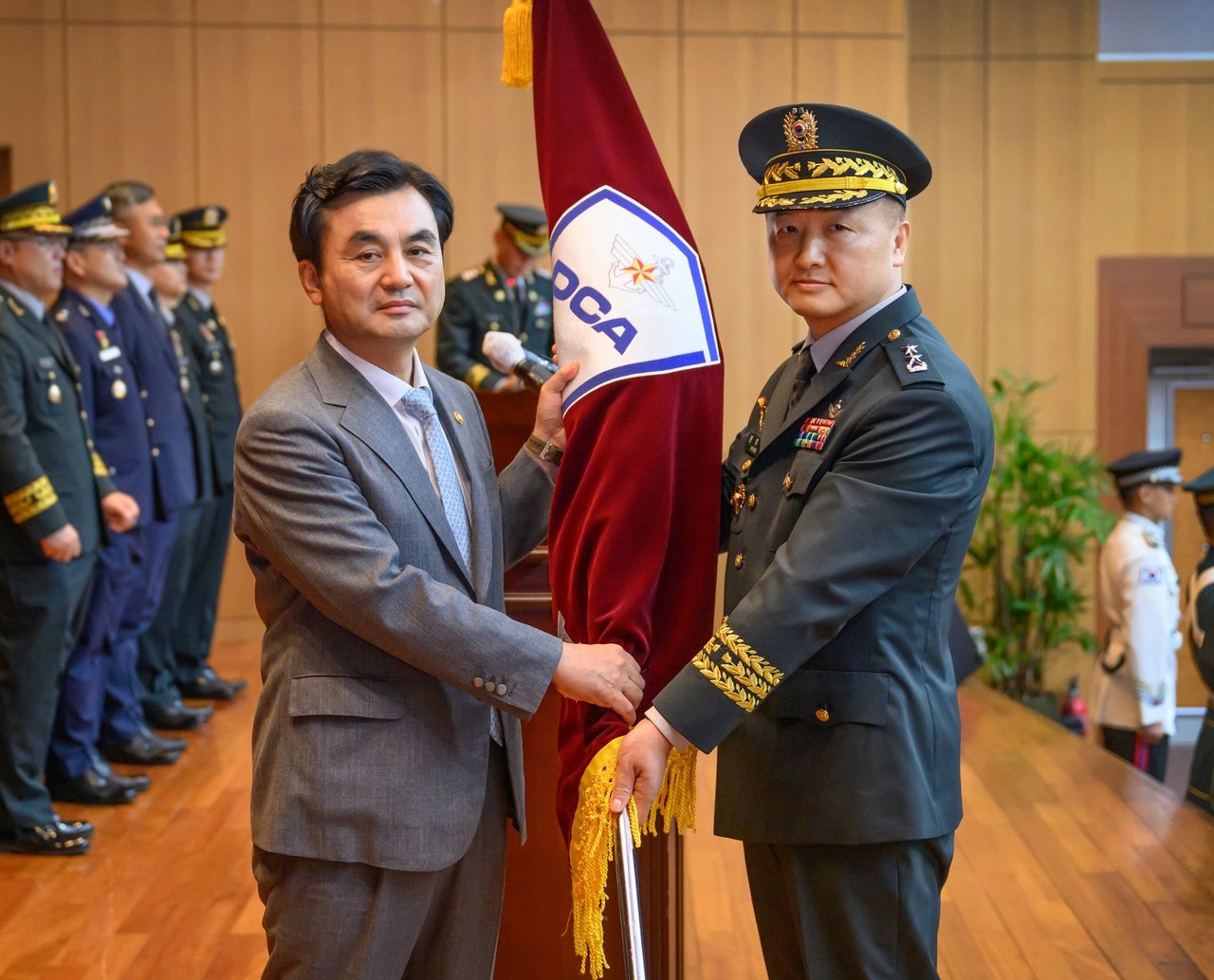
South Korea on Monday formally launched a new military counterintelligence system built around three separate organizations, completing the breakup of an agency that has faced numerous accusations of wrongdoing.
Defense Minister Ahn Gyu-back attended Monday’s launch ceremony for the Defense Counterintelligence Headquarters in Gwacheon, Gyeonggi Province. He called on the organization to focus on countering espionage and emerging security threats while remaining under firm democratic control.
Maj. Gen. Pyun Moo-sam, who served as acting commander of the now-defunct Defense Counterintelligence Command and oversaw its dissolution, was appointed the inaugural head of the new headquarters.
The headquarters, the newly created Defense Security Support Group and a security investigation unit under the Defense Ministry’s Criminal Investigation Command together replace the Defense Counterintelligence Command. The former command was formally dissolved Thursday after 49 years of institutional continuity under different names.
The government says the new structure will prevent a single military organization from controlling intelligence gathering, security inspections and criminal investigations.
Critics, however, point to the risk that dividing closely connected responsibilities could disrupt information flows and delay responses to espionage, military technology theft and other security threats.
What changed?
The Defense Counterintelligence Headquarters is primarily responsible for detecting and assessing threats.
It collects and analyzes intelligence on suspected espionage, foreign intelligence activities and threats involving defense companies and military technology. It also retains responsibility for defense industry security and cybersecurity.
The headquarters can identify and monitor potential threats, but it no longer has its own security investigation unit to pursue criminal cases.
The Defense Security Support Group focuses on whether military organizations are properly protecting classified information, facilities and communications systems.
It conducts central security inspections of corps-level and higher units and examines how breaches involving classified documents, military networks and other security procedures occurred.
The Criminal Investigation Command’s new security investigation unit handles suspected crimes. It can formally book suspects, conduct searches and seizures and investigate alleged espionage, military-secret leaks and violations of the National Security Act. It has also inherited the former command’s joint investigative authority during martial law.
A suspected defense technology leak could involve all three organizations.
The Counterintelligence Headquarters could detect suspicious contacts involving a defense industry employee and a suspected foreign intelligence operative. The Security Support Group could determine how the employee accessed or removed protected information. The security investigation unit would then identify suspects, secure evidence and pursue criminal charges.
All three stages could previously be handled within the Defense Counterintelligence Command.
Why was the DCC dismantled?
The immediate catalyst was the command’s alleged role in former President Yoon Suk Yeol’s Dec. 3, 2024, attempt to impose martial law.
Investigations and court proceedings have alleged that its personnel were deployed to the National Assembly and the National Election Commission and prepared operations related to the detention of political figures.
The controversy revived longstanding concerns over military counterintelligence organizations’ political involvement, from the Armed Forces Security Command’s role in the Dec. 12, 1979, coup to the martial law contingency document that prompted another reorganization in 2018.
Despite repeated changes of name and structure, intelligence gathering, personnel monitoring and criminal investigations remained concentrated within a single chain of command.
The latest restructuring abolished controversial duties including monitoring service members’ activities, gathering personnel-related intelligence and collecting unofficial assessments of officers.
Concerns over the split
Critics have raised concerns that separating counterintelligence, security oversight and criminal investigations could reduce efficiency and create gaps in cases requiring close coordination from initial intelligence collection through prosecution.
Counterintelligence cases often begin with fragmentary information rather than evidence sufficient to open a formal investigation.
The new organizations must therefore determine when intelligence should be transferred to investigators and how much can be shared without exposing confidential sources or ongoing surveillance.
An early transfer could alert a suspect, while a delay could allow evidence to be destroyed.
The Defense Ministry plans to establish guidelines governing the transfer of intelligence and operate consultative mechanisms among the relevant agencies to prevent such gaps.
Seok Jae-wang, a professor in the Department of Disaster and Security Management at Konkuk University, stressed the need for a formal coordination mechanism involving both military and civilian security agencies.
“The most desirable approach would be to establish a standing intelligence and investigation consultative body involving the National Intelligence Service, the Criminal Investigation Command and the police, similar to systems used in other advanced countries,” Seok said.
A separate concern is whether the restructuring has gone far enough in dispersing authority. Although the former command’s functions have been divided among three organizations, all ultimately remain under the authority of the defense minister.
“While operational authority has been divided, the defense minister still has ultimate control over all three organizations,” a Defense Ministry official said, speaking on condition of anonymity.
“Without effective checks on how the minister directs the agencies and combines the information they produce, the restructuring may disperse functions without fully dispersing control,” the official added.