
 KB News Desk
Organizers credit Tuesday opening, added screenings, as furor over ‘The Assassin(s)’ loomed large
The Busan International Film Festival recorded more than 200,000 admissions this year, its highest tally since 2015, organizers said Thursday, as the 31st edition reached its final day.
Screenings accounted for 200,043 admissions, according to the festival’s final report. Add in talk sessions, stage greetings and other side events, and total attendance climbed to 277,027 — about 40,000 more than last year.
The uptick was thanks to a reshuffled schedule, according to festival organizers. For the first time, the festival opened on a Tuesday instead of its customary Wednesday, and added an extra daily screening slot from Thursday to Sunday. The idea, they said, was to allow visitors who took time off work to stay on through the weekend.
The program itself featured 315 films, including 246 official selections from 59 countries, 94 of them world premieres. Kim Jong-kwan’s “The Table: Day and Night,” an 80-minute anthology that plays out over four conversations at a coffee shop, served as the opening film.
This year’s edition was the first since the festival earned “A-list” status from the International Federation of Film Producers Associations. It was also the first year the festival’s best film winner would be eligible for the Oscar for best international feature, following a change to the Academy of Motion Picture Arts and Sciences’ rules.
On the industry side, the Asian Contents & Film Market drew 30,484 visitors and 1,266 companies from 58 countries, according to the festival. Among the major deals, Korean and Japanese investors agreed to set up a joint 100 billion won ($74 million) fund to back content from both countries.
As in years past, the festival drew a slate of high-profile international guests. Michelle Yeoh, honored as Asian filmmaker of the year, was back in Busan for the first time in 15 years, while Alfonso Cuaron made his first official trip to Korea. Maggie Gyllenhaal, Isabelle Huppert, Koreeda Hirokazu and Fan Bingbing were also in attendance.
The 10-day event got off to a rocky start after being caught up in a political firestorm over a single film.
“The Assassin(s),” a political thriller based on the 1974 shooting that killed first lady Yuk Young-soo, was set for a public screening on the eve of the festival, with its cast slated to walk the opening-night red carpet. However, the movie became a national flash point within days of its Sept. 23 release, after online right-wing communities and conservative politicians accused it of promoting a defamatory conspiracy theory about then-President Park Chung-hee’s involvement in the incident.
The film’s director and cast withdrew from the festival before the opening, citing safety concerns. At a press conference on opening day, one of the programmers cut off a reporter’s question about the controversy, saying the festival had already made its position clear.
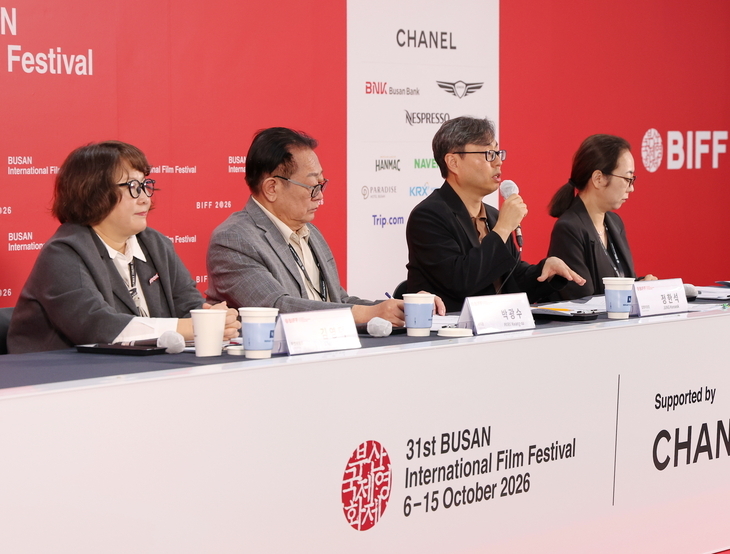
Festival director Jung Han-seok gave his account of that moment at Thursday’s closing press conference. “At the time, an actor’s safety was under threat,” he said. “So we were cautious. We didn’t want anything said off the cuff at an official event to put someone at risk or end up as political fodder.”
The question came up again the following day at the competition jury’s press conference, where Zhang Yimou, the jury’s president, said fiction need not be rooted in historical fact.
The festival was to wrap up Thursday evening with a closing ceremony at the Busan Cinema Center hosted by actor Im Si-wan. The seven-member jury was to hand out awards in five categories to films in the 13-title competition, with the best film winner to screen as the closing film.