
 KB News Desk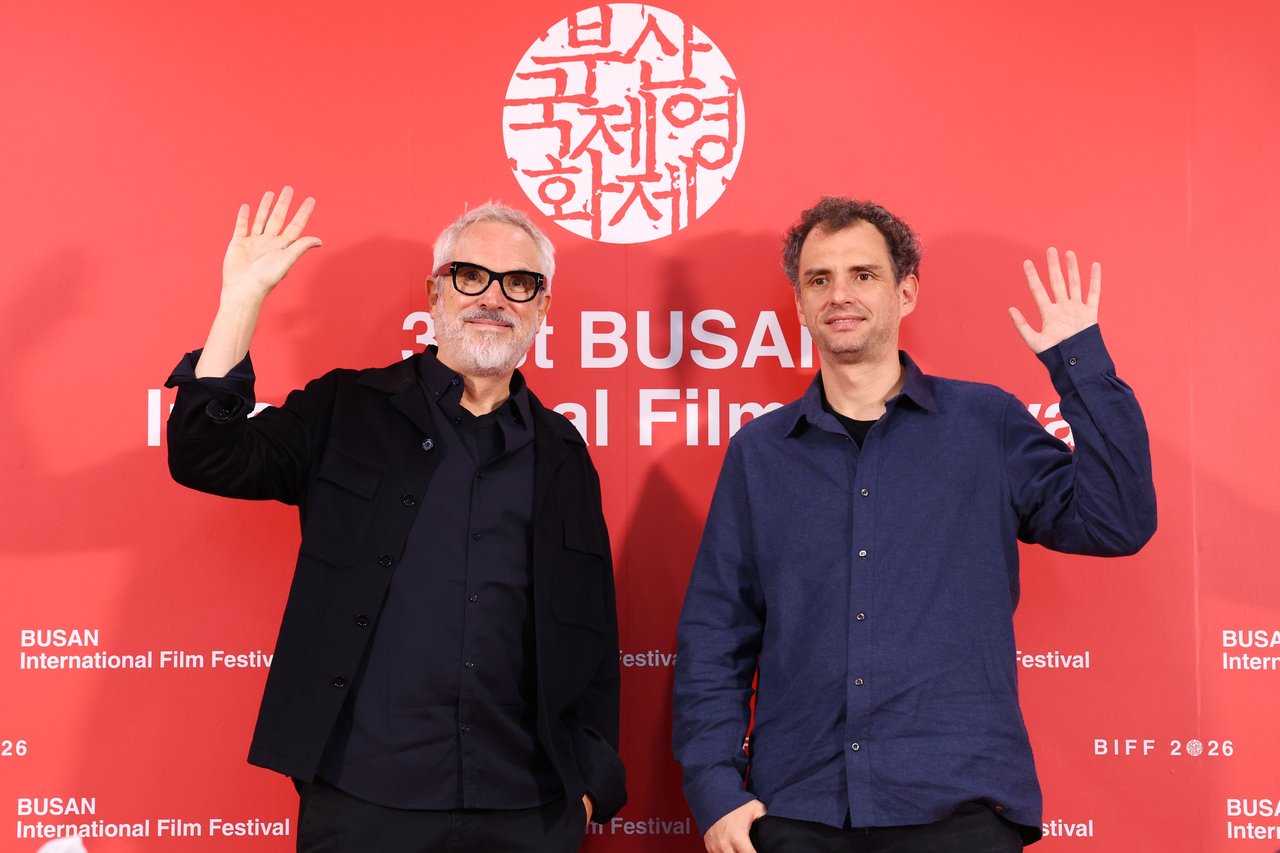
Oscar-winning director talks ‘Gravity,’ ‘Campeon Gabacho’ and working as father and son
BUSAN — Alfonso Cuaron shared his love of movies with his son. Having him follow in his footsteps was another story.
The two-time Oscar-winning auteur of “Gravity” and “Roma” is visiting Busan on his first trip to Korea, with a talk on his career scheduled for later Thursday at the Busan International Film Festival. Next to him was his son Jonas, a fellow filmmaker and longtime collaborator who co-wrote “Gravity” with him.
“I kind of discouraged him from studying film or anything related,” Cuaron, 64, said at a press conference Thursday morning at the Busan Cinema Center. “Then he became a filmmaker, and he told me, ‘What did you expect? I grew up in cinema. All your friends are filmmakers. We always talk about film.'”
“It was inevitable,” the son agreed. “I grew up watching movies with him constantly, and his passion for cinema kind of seeped into me.”
At first, the elder Cuaron wanted his son to have a life beyond the movies. He didn’t want Jonas to go through the heartbreak and agony that come with the job.
“I didn’t want him to narrow himself to cinema. As a father, I wanted him to have a broader schooling in culture and in the world,” he said. “There’s a part of filmmaking that’s rarely talked about. You see a lot of your dreams crushed, dreams that will never come to life. Maybe there was an instinctive part of me, as a father, that didn’t want him to go through that pain.”
Sure enough, Jonas didn’t head straight into the business. He studied literature and visual art, and at one point got into photography. Somewhere along the way, he came to see what drew his father to cinema.
“I understood why he loves cinema so much,” Jonas said. “It’s a medium that allows narrative, image, sound, music, a lot of art forms, to come together.”
Jonas Cuaron’s 2007 debut, “Year of the Nail,” was a feature-length montage of still photographs. The script that came along later, the survival thriller that would become “Desierto” (2015), caught his father’s eye.
“It was very refreshing to see him develop a language so different from mine. Selfishly, I realized it was a language I could use,” Alfonso said. “When I read that script, I said, ‘Help me write something like that.’ And then we wrote ‘Gravity.'”
He sees in his son a storyteller with a knack for straightforward narratives.
“[Jonas] has a big belief in audiences, in the power of a film to convey thematic elements without spelling them out,” Alfonso said. “Even growing up, he always responded to very straight, simple narratives filled with thematic and social elements.”
This year in Busan, the director’s chair belongs to the son, with the father on board as producer.
“Campeon Gabacho,” adapted from Aura Xilonen’s 2015 novel, follows a young Mexican immigrant who starts a new life in New York as an amateur boxer. The movie had its Asian premiere Wednesday in the festival’s World Cinema section.
The topicality of the story is unmistakable at a time when anti-immigrant sentiment rages on in many parts of the world. Jonas said he wanted to recast the conversation around migrants in human terms.
“In political discourse, immigration always gets boiled down to numbers and abstract ideas,” he said. “I wanted to give the immigrant story a human face. He’s a character who goes through hardship, violence and punches, but he’s also full of aspirations, romantic dreams and a very poetic imagination.”
For Alfonso, there’s no sidestepping the politics. “Every single film carries a political message, one way or another,” he said. “Talking about migration nowadays without a political standpoint is very difficult. But in a world where every migration story we hear is filled with tragedy, the hardships don’t necessarily take away the joy and the imagination.”
Asked what he enjoys most about working with his son, the father warmed up, sort of.
“What’s very pleasurable for me is when we have lunch. Then we can just be father and son,” he said.
“That’s good for me. Maybe he hates it.”