
 KB News Desk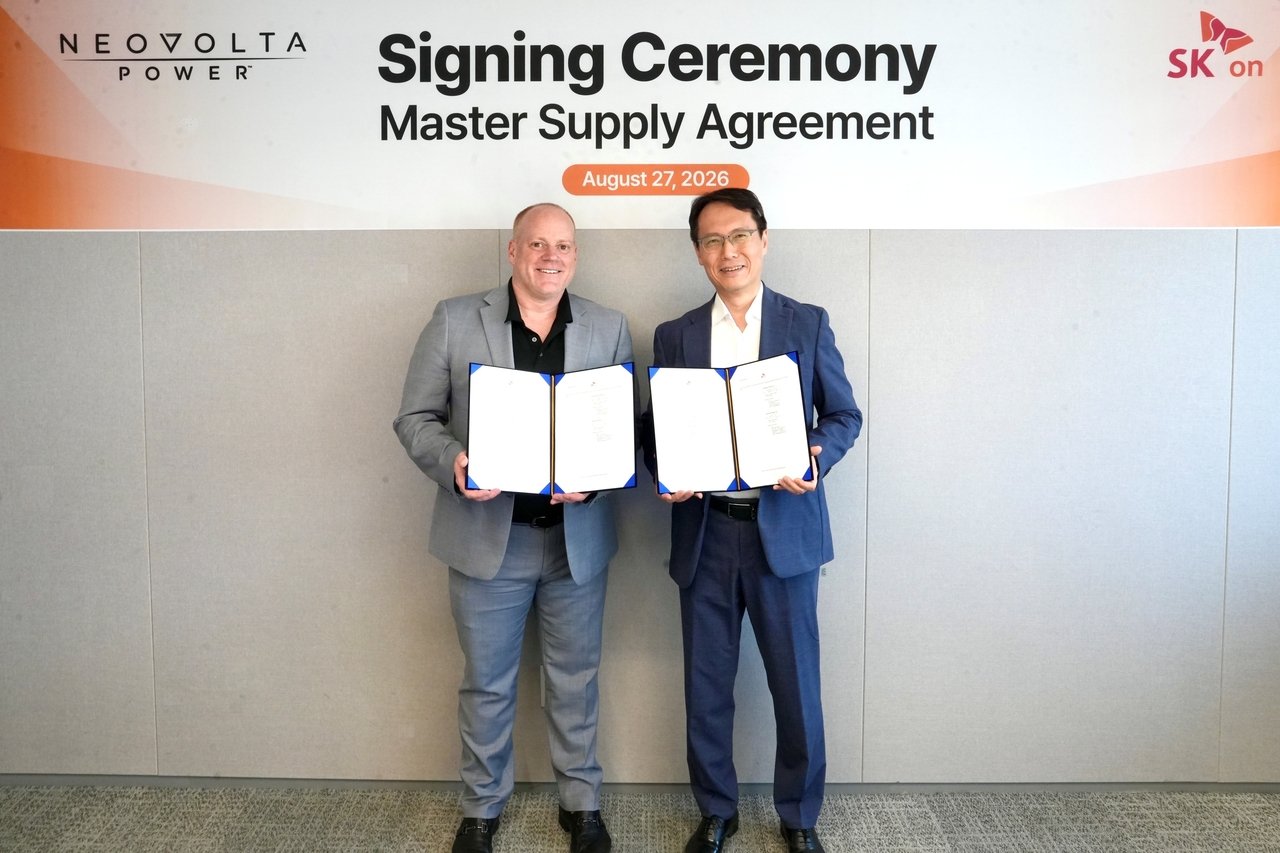
SK On said Monday it signed a major agreement with US-based NeoVolta Power to supply lithium iron phosphate, or LFP, battery cells for energy storage systems, expanding its footing in the rapidly growing North American power market.
Under the contract, roughly estimated at 1.5 trillion won ($1.09 billion), SK On will supply 9 gigawatt-hours of LFP pouch cells manufactured at its Georgia plant over five years, from 2027 to 2031.
Beyond the initial deal, the two companies plan to expand their partnership to a total of 18 gigawatt-hours. By the end of this year, SK On aims to secure another agreement to supply an additional 9 gigawatt-hours of battery cells under a “tolling arrangement.” This means SK On will provide the battery cells to NeoVolta Power, which will build them into finished battery packs for SK On to buy back.
Industry insiders say the arrangement allows both companies to leverage their core strengths in battery cell technology and local assembly while minimizing upfront costs and operational risks.
The deal marks SK On’s second major ESS contract in North America following an agreement for 1 gigawatt-hour with Texas-based Flatiron Energy last year.
SK On highlighted the contract as a strategic milestone in expanding its product portfolio beyond high-nickel electric vehicle batteries into grid-scale LFP energy storage — a booming market primarily driven by artificial intelligence data centers and grid renewal projects.
According to SK On, securing long-term orders in North America ensures stable production volumes, directly boosting factory utilization rates and overall earnings for its US operations.
“This partnership strengthens SK On’s position in the US battery ESS market and brings together SK On’s US-made LFP battery technology with NeoVolta Power’s growing energy-storage manufacturing capabilities,” said Choi Dae-jin, head of ESS business at SK On. “We view NeoVolta Power as a strategic partner as we expand our presence in the US energy-storage market.”
To bolster its presence in the US, SK On unveiled its dedicated ESS brand Gridon in Texas in June. A key pillar behind this expansion is its local manufacturing base of 100 gigawatt-hours, powered by standalone plants in Georgia and Tennessee alongside its joint venture facility with Hyundai Motor Group in Georgia.