
 KB News Desk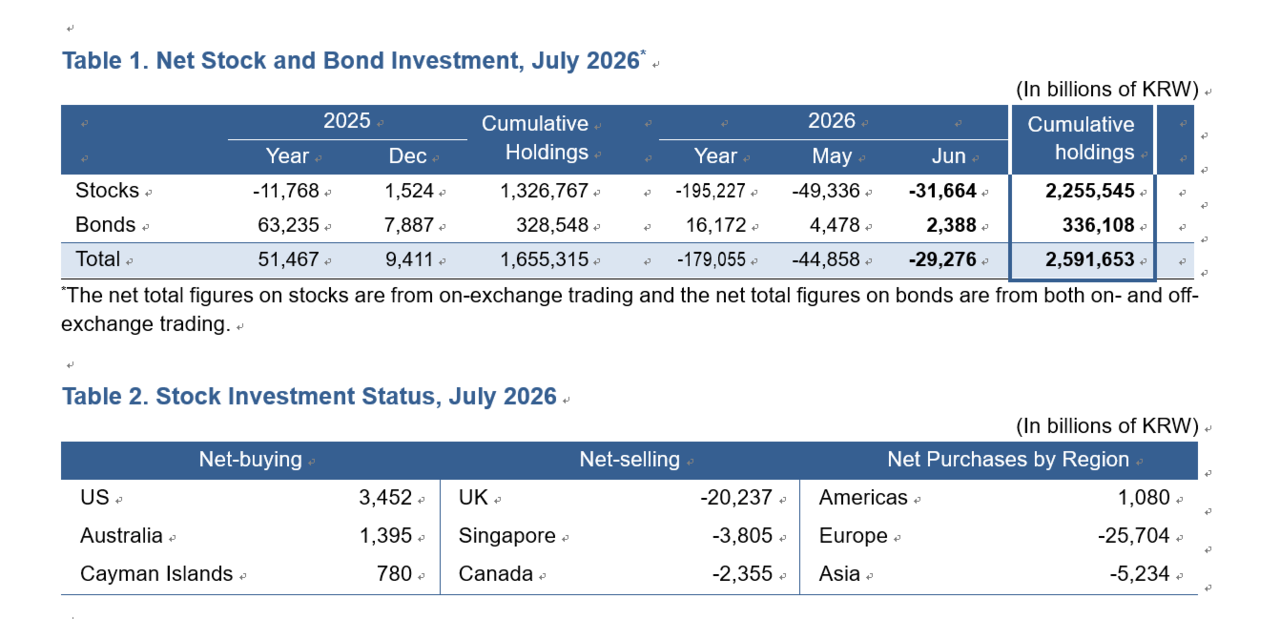
Bond investment extends for fourth month as foreign investors dump Korean equity
Foreign investors pulled sharply out of South Korean equities in July, with UK investors leading a massive stock sell-off even as US investors remained net buyers, data showed Friday.
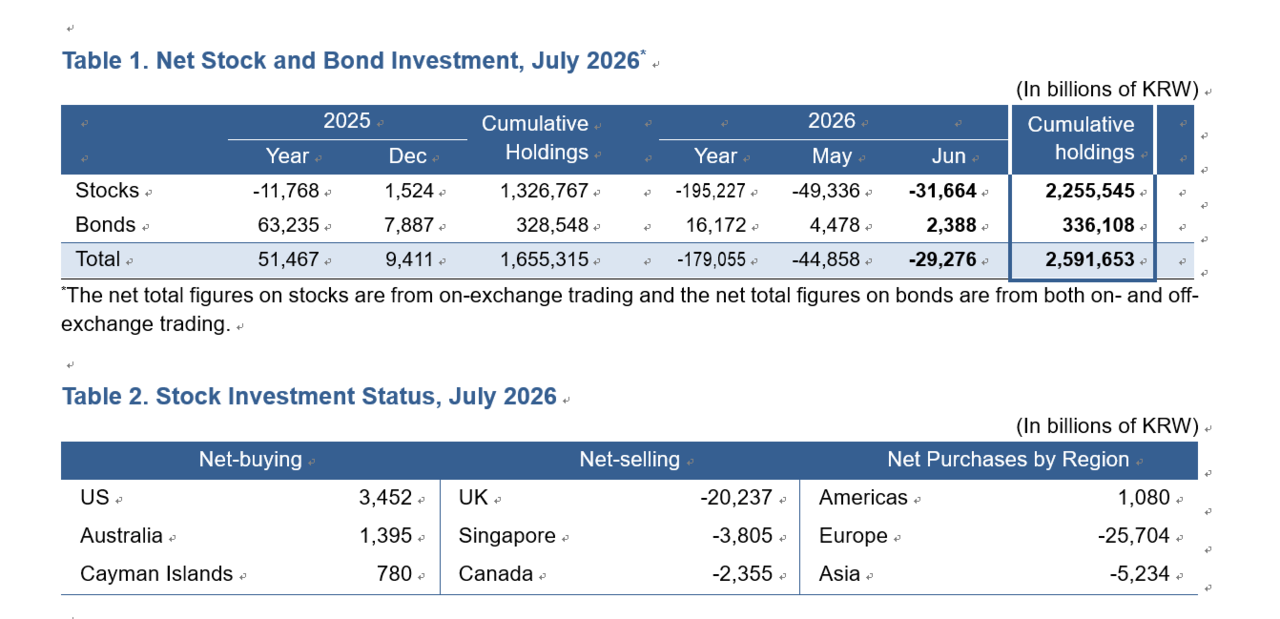
According to data released by the Financial Supervisory Service, foreign investors net sold 31.7 trillion ($22.9 billion) won worth of listed stocks in July, extending their net-selling streak to seven months.
Foreign selling was concentrated on the country’s main bourse Kospi, with investors net selling 30.8 trillion won. They also net sold 889 billion won worth of stocks on the Kosdaq.
European investors were the biggest regional sellers, offloading 25.7 trillion won worth of Korean stocks. Asian investors sold 5.2 trillion won and Middle Eastern investors sold 1.6 trillion won. Investors from the Americas, meanwhile, bought a net 1.1 trillion won.
By country, the UK was the biggest seller, with investors selling a net 20.2 trillion won worth of Korean stocks. Singaporean investors also sold a net 3.8 trillion won.
Meanwhile, US investors bought a net 3.5 trillion won worth of Korean stocks in July, while Australian investors bought 1.4 trillion won.
Foreign investors held 2,255.5 trillion won worth of listed Korean stocks at the end of July, equivalent to 35.8 percent of the country’s stock market capitalization. US investors held the largest share at 977.8 trillion won, followed by European investors at 675.9 trillion won.
At the same time, foreign investors continued to add Korean bonds despite the heavy selling in equities, marking their fourth consecutive month of net investment.
They bought a net 4.77 trillion won worth of listed bonds in July. After accounting for maturities, their net investment stood at 2.39 trillion won.
Asian investors accounted for the largest regional inflows at 2.7 trillion won, followed by investors from the Americas at 2.2 trillion won and the Middle East at 1.6 trillion won. European investors, meanwhile, withdrew a net 4.4 trillion won.
Foreign buying was concentrated in government bonds and longer-dated debt. Investors bought a net 2.6 trillion won of government bonds, while selling 200 billion won worth of special bonds.
By maturity, investors sold a net 5.9 trillion won of bonds due within one year, while buying 5.2 trillion won of bonds maturing in one to five years and 3.1 trillion won of bonds due in more than five years.