
 KB News Desk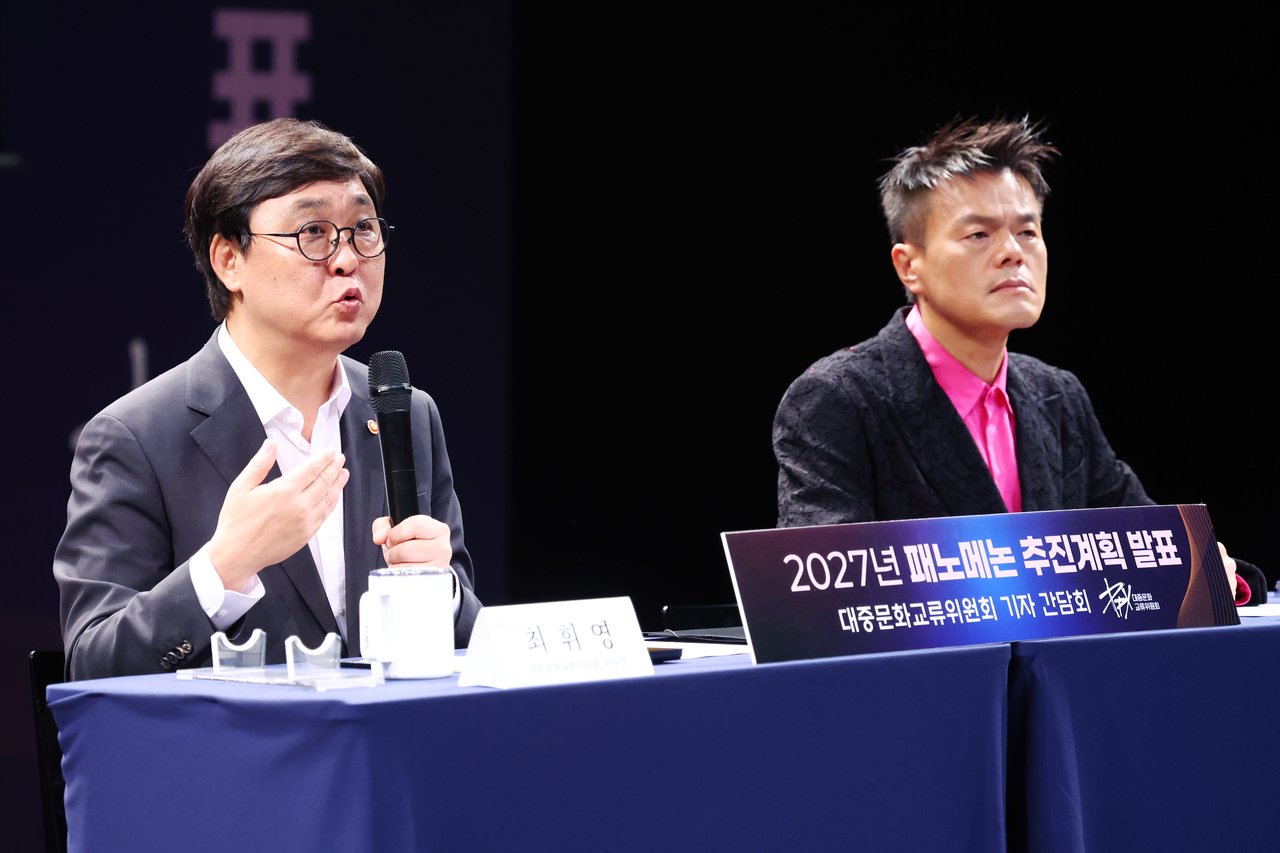
Korea’s next big K-culture bet is building an award show for fans, not stars
An 11-day K-culture festival built around fandoms will debut in December 2027.
The Presidential Committee on Popular Culture Exchange, co-chaired by Culture Minister Chae Hwi-young and JYP Entertainment founder J.Y. Park released its plan for the event, called Fanomenon, on Monday.
“The winner is not the artist but the artist’s fans, and the artist accepts on their behalf,” said Park, who is steering the event.
Fanomenon, also combining awards, concerts and other events, will run Dec. 2 to 12, 2027, opening with a gala on the first night. It will be split between Seoul Arena in Changdong, northern Seoul, which is due for completion in May 2027, and the second exhibition center at Kintex in Goyang, Gyeonggi Province.
The concerts will not be Korean acts alone. Park said he had approached top artists overseas about performing alongside the K-pop lineup and had been getting positive responses.
Chae said it was too early to announce a lineup but that Park was working to bring in “star names from Korea and abroad.”
“Until the time and the place are fixed, nothing moves — not the bookings, not the tie-ups, nothing,” Park said. “Locking that down was not easy. We had to work around the schedules of a great many artists, the agencies’ own situations and the country’s calendar. So pinning down the dates came first.”
Fandom is the winner
Each December, the awards will name the top 10 fandoms in each category, with a grand prize going to one of them. The prize is called Fandemonium, a coinage swapping the “p” in pandemonium for an “f,” which the organizers have trademarked along with the Fanomenon name.
Park said the rankings would be built on research data, with the metrics nearly finalized and a specialist firm to be chosen through a public bidding process. Fan activity is now traceable through large global charts such as Spotify and YouTube, he said, which is what makes the exercise possible.
Asked how the committee would handle the fairness disputes that follow year-end awards shows, Park said the answer was to establish authority quickly.
“Our goal is an awards show where nobody can say, ‘I’ll go if I’m getting an award and skip it if I’m not,'” he said. “If everyone understands that the organizers have no room to manipulate anything, that kind of pressure can’t exist.”
Park acknowledged that quantifying fandom carries risks, comparing it to acting and music prizes. “Giving an award for the best performance of the year makes very little sense in artistic terms. But it took root because the benefits were seen to outweigh the harm,” he said. Keeping the exercise honest, he added, would be partly up to fans themselves.
“In the end, the starting point was that we have to look at this through the lens of an industry — a fandom industry,” he said. “This is an industry, and if we define it and Korea becomes its leader, then we become the leader of an industry.”
He drew a line between fans and consumers.
“Fans don’t stay in the territory of consumers. They become partners,” Park said. “They do the marketing and promotion for the artist they love and support. That is an enormous thing.”
For the year-end awards, the committee projects 520,000 visitors, 200,000 of them from abroad, and an economic impact of more than 1 trillion won ($680.6 million). The figures were estimated by the Korea Culture and Tourism Institute using BTS’ Gwanghwamun concert as a benchmark, and count only paying admissions at the two venues, excluding the street events.
The budget is still being negotiated. Chae said the event would generate revenue through ticket sales and sponsorship rather than run purely on public money, while the government would fund work such as drawing overseas fans and moving them around the country.
Chae and Park both said what sets this event apart is not just that the government and the private sector are working together, but who is in the driver’s seat. The ideas and the planning came from the industry, not the ministry.
“When the government designs something and tells companies to do it, that’s very risky,” Park said. “This time they asked us what would help.”
He named two public goals: strengthening Korea’s culture industry as a whole, from the four majors down to new acts and smaller agencies, and giving young people around the world a way to grow closer through pop culture.
Sustaining K-culture long enough to hand it to the next generation, he said, was the reason he took the job in the first place. None of that, he added, rules out a profit.
“The most important thing is that this will make money,” he said. “It is close to impossible to draw private companies and artists into something that doesn’t.”
Park laid out Fanomenon as one of three projects the committee is pursuing. The December awards will be held in Korea every year. A separate Fanomenon Festival will begin in May 2028 and travel among major cities abroad, starting in Los Angeles — a project Park said resembles Coachella. The third is a plan to build K-culture centers in key overseas cities, each pairing a 20,000-seat venue with stores and exhibition space for Korean companies and government offices.
“The awards are held in Korea. It’s the festival that goes overseas,” Park said, adding that Los Angeles was chosen for its reach as the capital of the entertainment industry, which matters most for the first edition.