
 KB News Desk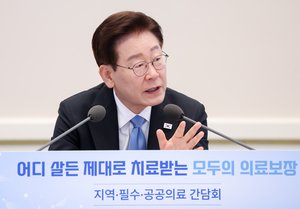
President Lee Jae Myung on Wednesday cast easy access to quality healthcare as a prerequisite for narrowing regional disparities in access to medical services and reviving South Korea’s quieter regions.
Presiding over a meeting at Cheong Wa Dae, he called for a stronger government role in reversing the concentration of patients and medical resources in the Seoul metropolitan area.
“Both demand and supply are concentrated in one place. We must find a way to address this problem, and I believe the solution ultimately lies in strengthening the public role,” said Lee.
The meeting took place shortly after the Lee administration unveiled three megaprojects in semiconductors, artificial intelligence data centers and physical AI, as part of its flagship push for region-led, balanced growth.
Lee said adequate medical services, alongside education and culture, are among the most important conditions that encourage people to settle in regional communities and help attract industries to those areas.
“What matters ultimately is the state of medical care — whether adequate medical services are available when I, or my family members, fall ill or need them,” Lee said.
Held under the slogan “healthcare for all, wherever they live,” the meeting brought together medical professionals, representatives of patient and civic groups, and experts to discuss a broad overhaul of the country’s regional, essential and public healthcare systems.
Discussions focused particularly on preventing avoidable deaths caused by delays in receiving emergency treatment and helping patients who are forced to travel outside their home regions to receive the care they need.
Health and Welfare Minister Jeong Eun-kyeong unveiled a strategy to strengthen regional, essential and public healthcare.
At its core, the plan seeks to ensure that people can receive routine, emergency and critical care within their own regions without having to travel to major hospitals in Greater Seoul, which includes Incheon and Gyeonggi Province.
The government plans to develop regional national university hospitals to a level comparable to that of the five largest hospitals in Greater Seoul, while expanding public hospitals and regional networks for emergency, trauma, maternal and pediatric care.
It will establish a 1.2 trillion won ($811 million) special account for regional and essential healthcare in 2027 and invest 3.6 trillion won annually through the national health insurance system to raise reimbursement rates for critical and essential medical services.
Long-term plans include increasing the number of medical professionals outside the capital through a regional doctor program, a national graduate medical school, and the establishment of medical schools in regions that currently lack one.
Seo Joon-beom, head of the AI Basic Healthcare subcommittee under the Presidential National AI Strategy Committee, presented a separate strategy for integrating artificial intelligence into the healthcare system.
The plan calls for introducing AI-assisted diagnostic and health management technologies at public health centers and local clinics, enabling patients outside the capital to receive advanced medical support comparable to that available at university hospitals.
AI would also analyze patients’ conditions and hospitals’ capacity in real time to direct emergency patients to appropriate facilities. The government plans to facilitate the sharing of personal medical records among hospitals to reduce duplicate testing and disruptions in care.
The strategy also seeks to connect public hospitals nationwide through a single AI platform, integrate fragmented medical data, and establish reimbursement, workforce, ethical and security frameworks for the nationwide adoption of medical AI.