

 KB News Desk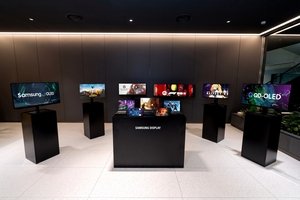
Samsung Display is on course to overtake LG Display in the mid-to-large OLED market by revenue in the third quarter, taking the lead for the first time as Korean manufacturers hold onto a display segment Chinese competitors have yet to break into.
Its share is projected to reach 48 percent against LG Display’s 47 percent this quarter, widening to 50 percent against LG’s 45 percent in the fourth. Together the two Korean firms hold about 95 percent of the mid-to-large market — panels for laptops and monitors — and are projected to keep that share through year-end. Chinese suppliers barely register, with EverDisplay at around 4 percent and BOE at 1 percent, according to market researcher Omdia.
Samsung Display added to that lineup Monday, saying it had begun shipping laptop makers a new class of OLED panel that meets True Black 1400, the top brightness grade VESA introduced this month. The panels reach 1,600 nits, roughly 40 percent brighter than conventional OLED, and last longer because they stack two light-emitting layers rather than one.
Lenovo’s Yoga Pro 9i Aura Edition became the first laptop certified to the standard on July 8, with Asus, Dell Technologies and MSI to follow through 2027.

The Korean lead here stands in sharp contrast to smartphones, where Chinese makers now ship about half of the world’s OLED panels by volume, though Korean firms still lead on revenue. Larger panels are harder to make at consistent quality, which keeps margins high. Samsung Display led both segments in the second quarter, with 71 percent of laptop OLED panels and 79 percent of monitors.
Now the company is moving to widen that gap. It has begun mass production on a new 8.6-generation line, which processes glass more than twice the previous size, cutting more large panels per sheet at lower cost.
The economics are the point. Cheaper large panels let OLED push out of a premium niche and into the volumes where it can challenge the mini-LED screens it competes with. Samsung Display is expected to supply about 2 million of those panels this year for Apple’s OLED MacBook Pro, having lifted the line’s yield above 90 percent within weeks.
That is the demand Chinese makers are chasing but have not reached. BOE, Visionox and CSOT are together investing close to 30 trillion won ($20.4 billion) in comparable lines, yet the money buys capacity, not customers. BOE has started its own 8.6-generation production but runs it below the yields mass output requires, the same bottleneck that has kept its iPhone panels at a minor share despite years of supply.
That advantage may not hold as firmly. China’s strategy of expanding capacity and cutting prices won it the LCD market, but it is harder to repeat in OLED where panels are built to each customer’s specifications rather than sold as a commodity, Lee Mi-hye, a senior researcher at the Export-Import Bank of Korea, wrote in a March report.
Even so, she noted, the technology gap in laptop and tablet OLED “has narrowed to about two years” from three to four in 2023, as Chinese firms apply what they learned making smartphone panels.