

 KB News Desk
Speakers at Seoul forum call for stronger data governance, human oversight and support for Global South
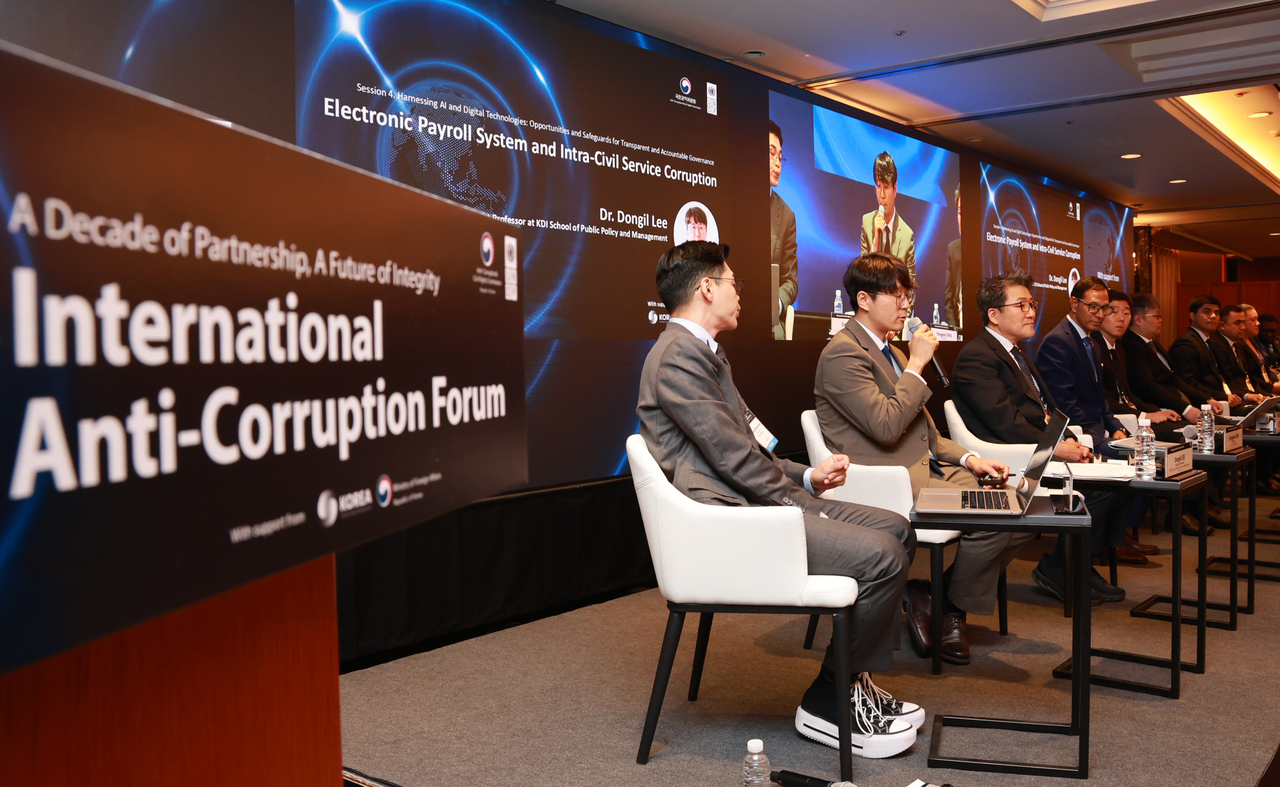
Experts warned Friday that artificial intelligence could serve as both a safeguard against corruption and a structural threat to transparency as the technology is increasingly embedded in public administration and oversight.
“In anti-corruption policy, AI can be a double-edged sword,” said Choi Yong-jeon, a professor at Daejin University, during the International Anti-Corruption Forum co-hosted by South Korea’s Anti-Corruption and Civil Rights Commission and the United Nations Development Programme.
“On one hand, AI makes preventive anti-corruption measures possible,” Choi said. “However, AI can also pose structural dangers, including algorithmic opacity, which could in turn conceal corruption.”
Choi said AI’s ability to process large volumes of data quickly could help detect signs of corruption, including collusion, repeated contract awards to the same bidders, improper spending and other red flags. Combining AI with blockchain technology or public data could also expand the range of information that can be tracked and verified, he said.
However, Choi warned that the spread of AI could also change the nature of corruption, moving it away from common forms such as bribery, improper solicitation and the granting of special favors, which are comparatively easier to detect.
Instead, corruption could hide behind AI-analyzed data that appears objective, he said.
Choi noted that corruption could be embedded in such data through bias, weighted variables or the overrepresentation of certain training data. Such distortions could make circumstances appear more or less favorable to specific companies or institutions.
“It becomes more difficult to spot the problem because it seems objective,” Choi said. “It creates an environment in which certain institutions could concentrate the power to monitor others, leading to abuse of power and the bypassing of democratic control.”
He also cited deepfake attacks as another challenge facing anti-corruption efforts in the AI era.
UNDP Global Anti-Corruption Advisor Anga Timilsina echoed Choi’s concerns, while pointing to the widening digital divide between the Global South and the Global North.
“Many now use AI-based anti-corruption tools, but there is little knowledge transfer to the Global South,” Timilsina said.
“Still, one in three people lack access to the internet globally, and now we are already in the AI revolution,” he added. “There will be unprecedented divergence with this AI amplification in the next five to 10 years due to the digital divide, and the Global South will be left behind.”
Timilsina said investment in local AI systems remains low, particularly in developing countries.
He also noted that in many countries, the public sector’s ability to regulate AI has fallen behind the pace of development in the private sector.
Timilsina offered four recommendations to anti-corruption leaders gathered in Seoul.
He called for stronger alignment between national digital and AI strategies and national anti-corruption strategies, backed by sustained, long-term investment in data governance and data quality improvement.
He also said AI initiatives should have clearly defined objectives and scopes, and stressed that results must be verified by humans.
The forum was organized to review the achievements of the anti-corruption technical assistance project jointly pursued by the ACRC and UNDP over the past decade, and to explore sustainable anti-corruption strategies and integrity governance in a rapidly changing global environment marked by AI.
The ACRC signed a memorandum of understanding with UNDP in 2015 and has since carried out the technical assistance project, which supports 14 developing countries in localizing South Korea’s anti-corruption systems.