
 KB News Desk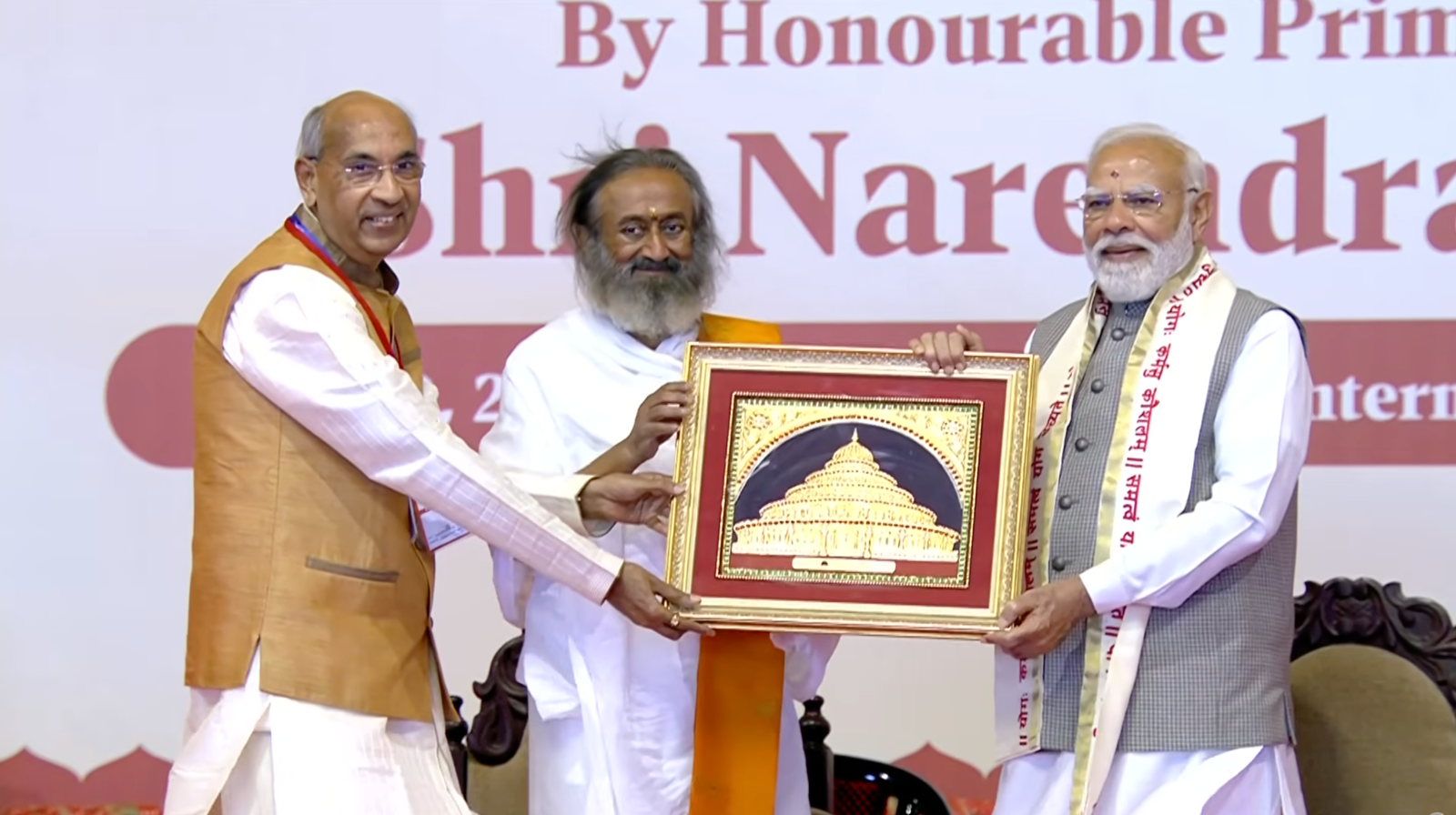
He started with no army, no budget and no political office. Just a breathing technique, a handful of followers, and an idea that a calmer mind could build a better world. Forty-five years later, the Prime Minister of India flew in to wish him a happy birthday.
Narendra Modi arrived at the Art of Living International Center in Bengaluru on Sunday to join Gurudev Sri Sri Ravi Shankar in marking two milestones at once: the 45th anniversary of the Art of Living movement and its founder’s 70th birthday. What greeted him was not a quiet spiritual retreat. It was a gathering of more than 100,000 people from 182 countries — a number that would rival the attendance of most international summits — assembled on the outskirts of a south Indian city to celebrate a man who built one of the world’s largest humanitarian movements from a single idea about the human breath.
The occasion carried the weight of something larger than a birthday. It was, by any measure, a statement.
A Temple Built for Stillness
The centerpiece of Sunday’s event was the inauguration of the Dhyan Mandir — a dedicated meditation space designed to serve practitioners across cultures, faiths and backgrounds. The structure, described by organizers as representing one of the world’s largest meditation communities, is built for collective inner work: mass meditation sessions, chanting, and the kind of sustained silence that is increasingly difficult to find in the modern world.
Modi called it a landmark. “I am confident that the Dhyan Mandir inaugurated today will become a center of peace and solace for thousands of people across generations,” he said, adding that when resolve is clear and work is done in the spirit of service, every effort bears fruit.
The temple’s opening was more than ceremonial. For the Art of Living, it represents a permanent physical anchor for a movement that has largely operated through people — volunteers, teachers and practitioners who carry its methods across borders without institutional infrastructure. The Dhyan Mandir changes that. It gives the world’s meditators a place to return to.
The Politician and the Spiritual Teacher
Moments of genuine warmth between political leaders and spiritual figures are rare in public life. Sunday offered one.
Standing before the crowd, Modi described Gurudev Sri Sri Ravi Shankar as “a living embodiment of India’s timeless tradition of giving — giving knowledge, giving peace, giving hope.” He recalled the consistent energy of service he had experienced every time he visited the International Center. Then, in a moment that drew a roar from the audience, he turned personal. “I am yours,” Modi said, “and I am where I am because of you.”
Gurudev Sri Sri Ravi Shankar, for his part, reflected on the decade of change that has reshaped India’s place in the world. “Today, Mother India and the people of India walk with pride,” he said, addressing Modi directly. He pointed to something specific and striking: a fundamental shift in how India is perceived globally. “In less than ten years, you transformed India from a country that asked, into a country that gives.”
It was a line that landed with the force of a headline — and for good reason. India’s emergence as a credible global power, its pivot from aid recipient to development partner, and its growing confidence on the world stage have been among the defining stories of the past decade. That a spiritual leader chose to frame it that way, before 100,000 people and an international audience, said something about where India now locates its sense of self.
Ambition on the Ground
Sunday was not only symbolic. Modi used the platform to launch nine nationwide service initiatives spanning education, reforestation, tribal welfare, women’s empowerment, healthcare access, prison reform and digital literacy — a portfolio that reflects both the breadth of the Art of Living’s grassroots reach and the government’s interest in leveraging civil society to close gaps that public institutions alone cannot fill.
The numbers are significant. Under Mission Green Earth, the organization has already planted over nine million saplings across 19 states in the past year alone. It now aims to plant 4.5 million moringa saplings and 17,500 sacred grove sets comprising nearly 90,000 trees including Banyan, Peepal and Neem — species with deep ecological and cultural significance in India.
Twelve rural transformation hubs are being launched across 11 states. Leadership training will reach 50,000 youth and women, building on a base of over 600,000 existing beneficiaries. A tribal welfare mission will expand into 450 villages. Nine telemedicine centers will extend specialist healthcare into underserved regions. And the organization’s prison reform work — already active across hundreds of facilities — will scale to 550 prisons, reaching nearly 60,000 inmates and staff with trauma relief and vocational training.
Its free school network, currently educating more than 120,000 children across 2,754 villages in 22 states, is set to grow from 1,356 to 2,000 schools.
Modi drew the thread together. “I am confident that society is more powerful than politics and governments,” he said. “Any government can be successful only when society is actively participating in the creation of the nation.”
Forty-Five Years and a Billion Lives
The Art of Living did not begin with ambitions of this scale. Gurudev Sri Sri Ravi Shankar founded the movement in 1981, anchored around a breathing-based stress elimination technique called the Sudarshan Kriya. Its early trustees reflected an unlikely coalition — among them former Chief Justice of India Justice P. N. Bhagwati, deeply spiritual in orientation, and Justice V. R. Krishna Iyer, known as a committed rationalist. That both were drawn to Gurudev Sri Sri Ravi Shankar’s vision spoke to something that transcended ideology.
Four and a half decades on, the organization claims to have reached more than a billion lives across 182 countries through programs in breathwork, meditation, education and service. It operates without the backing of a government, a corporation or a religious establishment. It runs on volunteers.
Sunday’s gathering — Union Ministers, state Governors, members of parliament, entrepreneurs, farmers, rehabilitated prison inmates and international delegates assembled on a hillside in Karnataka — was the most visible expression yet of how far that original idea has traveled.
Modi captured it plainly. “The biggest reason for such achievements in the country,” he said, “is our youth — and the Art of Living.”