

 KB News Desk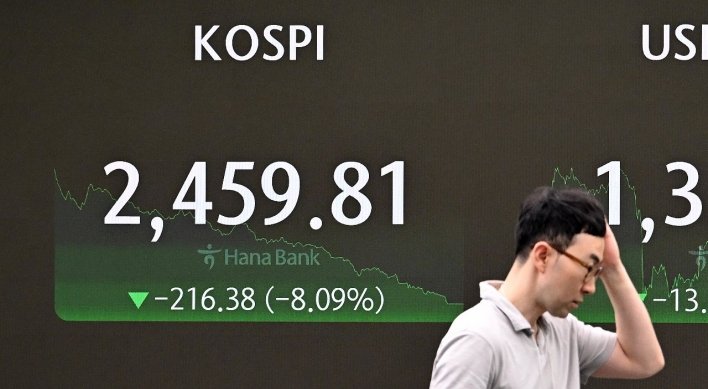
South Korean shares dived more than 8 percent on Monday, triggering the stock exchange to temporarily halt the main Kospi and secondary Kosdaq markets, as investors were gripped by fear that the US economy may head toward a recession.
A record 190 trillion won ($139 billion) was wiped off the Kospi market, as it tumbled 8.77 percent, or 234.64 points, to close at 2,441.55. This is the first time since the benchmark bourse opened that it has fallen by more than 200 points, recording the largest drop in its history.
The Kosdaq shed 11.3 percent to close at 691.28.
Korea Exchange, the country’s bourse operator, activated the circuit breaker on the Kospi for 20 minutes when it dropped by as much as 8.1 percent during the afternoon trading session.
Despite the measure to prevent panic selling, shares slid further to over 10 percent immediately after trading resumed.
Circuit breaker trading curbs kick in when prices fluctuate 8 percent from their previous close for over a minute.
The Kosdaq market’s fall of 8.05 percent also prompted a circuit breaker at 1:56 p.m.
It is the first time the Seoul stock market has activated a sidecar on the Kospi market in over four years, since March 2020 when COVID-19 was first declared a pandemic.
Yang Hae-jung, a strategist at DS Investment & Securities, said the market reaction was “excessive” given that a recession has not actually arrived and the US has room to cut its key rates.
“The Kospi fell more than 10 percent three times – when the dot-com bubble burst, Sept. 11 terrorism occurred and global financial crisis hit markets. If the current situation plays out in a similar way as the previous three cases, it will take about a month to digest,” Yang said.
Before markets opened, Korean financial authorities, including Yoon In-dae, assistant minister at the Ministry of Economy and Finance, held a meeting and vowed to remain vigilant about market volatility with the around-the-clock monitoring system.
“As volatility in the global financial market has expanded and uncertainties such as the resurgence of geopolitical instability in the Middle East remain, the government and the Bank of Korea maintain a high level of vigilance and a 24-hour monitoring system jointly with relevant agencies to respond to each situation when necessary,” the ministry said in a statement.
In a separate meeting, Financial Services Commission Chairman Kim Byoung-hwan warned of imminent shifts in economic conditions here and abroad.
“As we are at an inflection point where domestic and foreign economic conditions, such as the recent monetary policy of major countries, the US economic outlook and the domestic real estate market, are showing significant changes from the trends of the past few years, a more strengthened inspection and response to market risks is necessary,” he said.
Equity markets tumbled sharply across most of Asia, continuing to rattle from last week’s big slide in US shares, which stemmed from recent US economic data that rekindled concerns that the US has entered the path of recession.
Echoing the sharp decline of US semiconductor stocks such as Nvidia and Intel, Samsung Electronics fell by 10.3 percent, reaching a low of 71,400 won. SK hynix lost 9.87 percent.
“As worries about US semiconductor AI profits continue to worsen, even Nvidia has worsened investment sentiment and intraday losses are widening for both Samsung Electronics and SK hynix,” said Shinhan Investment & Securities analyst Lee Jae-won.
Japan’s Nikkei 225 nose-dived as much as 12.4 percent, Taiwan’s TWSE Capitalization Weighted Stock Index slid 8.35 percent, while Hong Kong’s Hang Seng and China’s SSE Composite Index shed 1.46 percent and 1.54 percent, respectively, as of 5 p.m.
The US Department of Labor announced that the number of new nonagricultural jobs increased by 114,000 last month, significantly lower than market expectations of 185,000. The unemployment rate stood at 4.3 percent, also exceeding market expectations of 4.1 percent.
Some macroeconomic experts blame the US Federal Reserve’s long delay in making an interest cut for exposing the US economy to the risk of recession.
Major US financial institutions predict the Federal Reserve will implement a series of “big cuts,” starting by lowering rates by 0.5 percentage point in September, which could cause another market fluctuation.